Changyu Wine Museum -- Numerous Bygones


Inside the Museum, precious old photos, ancient winery apparatus, earth-figures demonstrating wine-making process, all are telling a long history of the industry. Zhang Bishi had left no stone unturned in his search for specialists and changed three wine-makers before he invited Baron M. von Babo, of a long-standing wine family from Austro-Hungarian Empire, as his first chief wine-maker. Changyu's first general manager Zhang Chengqing devoted all his life to the winery and died young; the license for Changyu was issued by the then Prime Minister Li Hongzhang personally; Weng Tonghe only asked for 50 tires of silver for each character he wrote, as nominal brush-polishing fee; Changyu was awarded gold medals and a Grand Prize at the Panama-Pacific International Exposition in 1915 for Cognac Brandy,Red Rose Wine, Gewurztraminer,White Riesling .... All these stories are here flowing, spreading, making visitors meditative in amazement.
Here also, lots of dedications of dignitaries are kept as fond memories. Dr. Sun Yat-sen's inscription - "品重醴泉"is said to be his only one for any enterprise; Kang Youwei visited the Winery two times in 1917 and 1927 and left behind marvelous sister poems. General Zhang Xueliang also praised Changyu's management with reference to history --"圭顿贻谋;" Professor Liu Haisu, a renowned modern Chinese painter, wrote "醇厚芳香,朝晖光灿" (rich and aromatic, as brilliant morning sunlight), for the Winery at the age of 88 - just to name a few. The number and degree of traces left here by dignitaries and celebrities are an extreme wonder to see, making Changyu's legacy more charming.
A trip in the Museum, a walk in the mysterious century old underground cellar, is an unforgettable experience for life. Spiral stairs downwards, whiffs of wine aroma upwards, making people involuntarily breathe deep. Such a completely different world down in the cellar! Eight arch tunnels crossing each other like in a labyrinth, rows of barrels with wine or brandy lying there as in sleep, with the diffusive aroma as their dreams. Among the century barrels, three were known as the King Barrels in Asia, each with the volume of 15 tons. It would take a heavy drinker 80 odd years to drink all in one barrel half a kilogram a day. Many visitors tie red ribbons with their names on the King Barrel, and make silent wishes for good fortunes and blessings it's said to be able to bring about.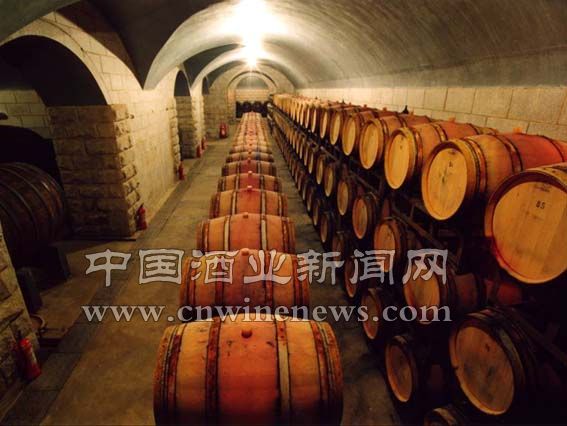
Absolutely no leakage so far has been observed in this oldest cellar in Asia, 7 meters underground 1 meter under sea level, and less than 100 meters away from the coast. This is a miracle in the construction history of the world. According to one tour guide, huge adversities was overcome during the construction. Started in 1894, collapsed soon later because of the sand-earth structure, renovated with western methods with steel fabrication and later inundated in torrential rains due to steel rust, and other frustrations. Countless experiments and collective wisdoms eventually led to the combination of Chinese-Western solution, a stone arch top, with stone-cement wall filled with broken bricks, sand and stones, making the cellar body particularly strong and water-tight. It took 11 long years for the final completion of the project in 1905.
Wandering in the cellar and reviewing all bygones, make one mistake now for then/present for past. In the flickering and murmuring underground bar, cup in hand, wine in mouth, I unconsciously drink away.
