Bubbles at a Discount for Consumers Trading Down(1)


Chester Higgins Jr./The New York Times
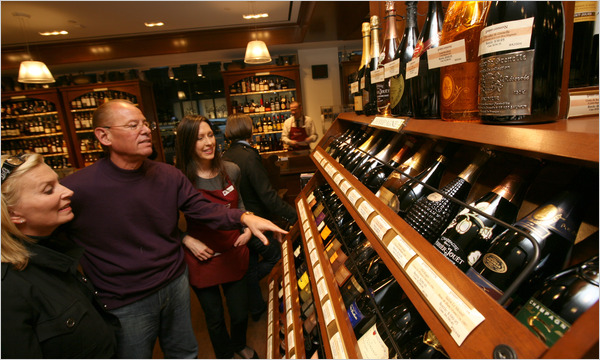
Brenda Terris, left, and Ed Weltman shop for Champagne at Sherry-Lehmann Wine and Spirits in Manhattan with the help of Tamara Wick.
ÉPERNAY, France — For generations of French Champagne makers, the threat of calamity has been a constant companion, whether it is winter freezes or spring frosts, phylloxera parasites or Nazi occupiers.
Champagne sales drop in key markets such as Britain, Japan and the United States.
Now add to the list a drop in Champagne sales in all the top export markets, particularly the United States, Britain and Japan. All had seemed to have insatiable appetites for the extravagant, delicate bubbles in recent years — until popping housing bubbles sent the global economy into a downturn. The weak currencies in those export markets have also hurt.
The grandees of the Champagne region — Moët & Chandon, Perrier-Jouët and Piper-Heidsieck — are putting on a brave face heading into the holiday rush, the heady weeks from November to New Year’s Eve when they usually sell millions of bottles and reap most of their annual profits.
So far, retailers in the United States are offering some modest discounts on their Champagne, though some bigger price cuts can be found on more expensive merchandise. Sherry-Lehmann Wine and Spirits, a major retailer in New York, is selling a gift-boxed Veuve Clicquot La Grande Dame 1998 for $130 in the coming holiday season, down from about $150 in last year’s holiday catalog.
But Jon Fredrikson, of Gomberg, Fredrikson & Associates, a wine industry consulting company in the San Francisco Bay Area, said retailers were probably waiting until the holiday season to decide whether to slash prices on their higher-end brands.
Overseas, more significant discounting has already started. Bottles of Moët & Chandon and Veuve Clicquot are one-third off with the purchase of two — £24.99 ($41.69) at one top British retailer. In Australia, a price war has broken out among the major liquor retailers.
Even in France — the biggest market for Champagne — the supermarket giant Carrefour is laying holiday plans to sell Champagne for less than 10 euros ($14.90). A year ago, those bottles might have sold for 12 euros.
Officially, bargains are a crass notion for the industry, which carefully cultivates its image of luxury and glamour.
“We are artisans and it’s not interesting to me to talk about the market or prices,” said Pierre-Emmanuel Taittinger, president of Champagne Taittinger in Reims in the Champagne region of northeastern France. “We are not selling perfume or soap or cars. My job is to find a million friends across the globe that drink five bottles of champagne a year.”
But deep in the wine cellars, there is definitely something going on, as sales to both the United States and Britain tumbled in the first nine months of this year. Britain was down 33 percent, to 12.2 million bottles. Exports to the United States were off 43 percent, to 4.56 million bottles.
Producers also have an image problem.
“It was a cliché that Champagne did well when times were bad,” said Robert Joseph, editor at large of Meininger’s Wine Business International magazine. “But this recession has an added element to it in which conspicuous spending — bling — is out of fashion.”
American consumers are clearly trading down. Sales of cheaper sparkling wines — typically produced in Spain or Italy — are up 10 percent this year, while sales of imported wines priced at more than $25 are down 21 percent, according to Danny Brager, the group client director for alcohol for Nielsen, which tracks sales in the United States.
“The $64 million question in this environment is how will consumers respond heading into this critical time, when we know they are under extreme wallet pressure,” Mr. Brager said.
Nielsen figures show that Taittinger, one of the top 10 producers, has responded by spending more on promotional displays in American stores. The percentage of volume sold with promotions is up to 50 percent, from 35 percent, over the last two years.
Others are deploying their most reliable weapons: glamour and indulgence.
Moët & Chandon, which is the leader in the American market, is offering a 300 euro ($447) “celebration case” that includes a magnum of Moët Imperial, Champagne flutes and medallions with colored Swarovski crystals encased in gilded bubbles.
“We still believe Champagne is needed in tough times,” said Marc Jacheet, the global director for Moët & Chandon. “It’s not a price battle that we want to get into. We do discount, but selectively and reasonably. We believe more in providing rituals.”
So does Moët’s rival, Rémy Cointreau. Its Piper-Heidsieck label is promoting a $500 gift package of a bottle of brut Champagne and a hand-blown, crystal ruby stiletto shoe designed by Christian Louboutin. The company’s YouTube video is a romantic dream scene of a modern Cinderella who leaves behind a shoe just like it for her distraught lover, who is consoled by the Champagne overflowing from the instep.
“I don’t expect people to be drinking out of a shoe at midnight on New Year’s Eve,” said Michelle DeFeo, a vice president for marketing for Rémy in the United States. “What we’re reminding them is that Champagne has this sensual side so maybe you should share a bottle some night with your loved one.”
