Mexico's valley of wine(1)


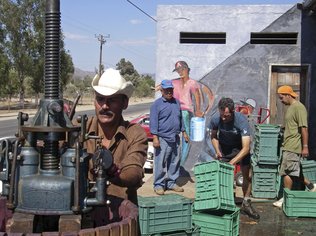
VALLE DE GUADALUPE, Mexico – Hot, dusty, rattled by rocks and ruts of the road, and as confused as lost conquistadors, we slump into chairs at the reception office of the inn Adobe Guadalupe.
Minerva Cerda, graciously bearing dewy glasses of a bright rosé, materializes immediately through a side door. With the first sip – a gulp, actually – we relax, stop worrying about the car's undercarriage and begin to look more closely at our surroundings.
Though Adobe Guadalupe has just six rooms, it's one sprawling hacienda, with a massive fountain in the courtyard, a winery off to one side, a pool and hot tub on the other, collections of teacups and cut crystal artfully arranged here and there, and three galumphing Weimaraners enjoying the run of the place.
We glance out doorways and windows, seeing vineyards roll in orderly rows across the vast valley floor. It looks like the Napa Valley, but we're in Baja California.
More specifically, we're wrapping up our first day in Valle de Guadalupe, about half an hour northeast of Ensenada, a coastal party town roughly 70 miles south of San Diego.
In Ensenada, the tourist draws are fish tacos and beer. In Valle de Guadalupe, it's wine. There's not much here other than vineyards and wineries, slowly squeezing out the orange and olive groves, alfalfa fields and horse farms that have long set the tone for the valley's rich agrarian history.
Wine lovers won't be disappointed with what they find in the hot, arid Valle de Guadalupe. Although swine flu and fear of violence have deterred many Americans from visiting, we couldn't resist it.
An estimated 80 to 90 percent of the wine made in Mexico is made in Baja California, and most of that is produced by the 30 or more wineries in this valley. The producers range from corporate giants to boutiques no bigger than a one-car garage.
Although most of Baja is desert, Valle de Guadalupe benefits from its proximity to the Pacific Ocean and by topography similar to Santa Barbara County. In both viticultural areas, maritime breezes stream east though a gap in the coastal hills and are more or less confined by ridges, providing cool breaks from torrid temperatures, helping maintain the sugar and acid balance crucial for expressive wine grapes.
Wineries are apt to be far back on a washboard road or tucked in a ravine up a tortuous path best traversed with a high-riding four-wheel-drive beater.
"I like to tell people that this is off-roading in the wine country," says Steve Dryden, a retired U.S. National Park Service naturalist who came here a decade ago to write about wine and guide tours.
Our first stop on Day 2 is Vinicola L.A. Cetto, one of the larger and more historic wineries in the valley, dating from 1974. Out front, members of the Kumai tribe oversee a table at which they sell bundles of fresh rosemary and sage, and baskets woven with pine needles.
Inside, Camillo Magoni, the native Italian who has been Cetto's winemaker from the start, is lining up bottles to showcase the winery's portfolio, from an inexpensive everyday petite sirah to a pricey blend of cabernet sauvignon, nebbiolo and montepulciano he makes every five years to salute the winery's founder, fellow Italian Angelo Cetto.
"Mexico is known for tequila, beaches, archaeology, Corona and spring break, and in the near future for wine, I hope so," says Magoni.
He's been involved in the valley's wine trade since 1965 and has seen it evolve from a focus on large yields for simple brandy to today's intensifying concentration on small yields, premium varietals and high-end proprietary blends. The brandy has all but disappeared, succeeded by dry table wines, Magoni says.
"This is the best area in Baja for wines, but it's not the only one," he boasts, noting that such neighboring valleys as Las Palmas to the north and Santo Tomas and San Vicente to the south also yield fruit for fine wine.
While demand for Mexican wine is growing, particularly in Mexico City, Guadalajara and resort cities with a sophisticated and affluent clientele, vintners say, Baja's wine trade is hamstrung by forces natural and bureaucratic. Drought, coupled with Ensenada's tapping of the Guadalupe River, is keeping growers from expanding for fear they won't have adequate water to irrigate their grapes.
