Plainly put, simply grand(1)


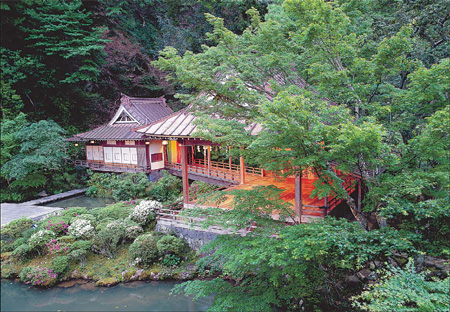
A 100-year-old wooden stage, where traditional Noh plays and modern
productions are performed, is the centerpiece of Asaba, one of
the best ryokans in Japan. provided to china daily
Nowhere is Japan's quiet luxury more evident than in its onsen ryokans - traditional inns with hot springs - Ou Shuyi finds
Japan's charm is often compared to that of the ideal beauty, subtle and elusive - you can hardly resist it even though you cannot fully understand it. Here, beauty lies in the depth of simplicity and comes in tiny packages: the dessert plates on dinner tables, the straw smell of the tatami mats on the floor.
This is a world of quiet luxury, with nary a trace of flashiness, every detail deliciously exquisite in its utter simplicity.
I got to experience this understated elegance and luxury at Asaba, one of the country's best onsen ryokans (Japanese-style inn with hot springs), during my recent trip to Japan.
Nestled in the mountainous town of Shuzenji on the Izu peninsula, about two hours by train from Tokyo, the 510-year-old inn has been run by the Asaba family for 10 generations and is a good marriage of history and nature, of the traditional and the modern.
The entrance is so inconspicuous - a wooden gate at the end of a narrow path - we think we have wandered up to the front door of someone's house.
However, as with many things in Japan, size quickly becomes unimportant amid the expansive charm and elegance we encounter inside.
Japanese hospitality fills every nook and cranny. Kimono-clad staff greet us like old friends, with their gracious deep bows and pleasant smiles. The personalized service of the housemaids is unobtrusive and effective.

Slippers appear as soon as we take off our shoes at the door. Hot towels, green tea and sweets appear one after another while we wait in the lobby. Guided by another round of bows, we are led to our suite. No language is needed - everything is perfectly understood.
Built in traditional Japanese style, the complex is defined by its intricate, carved landscape. A well-tended garden, surrounded by a bamboo grove, with a pond at its heart, is like a piece of living artwork, every detail meticulously crafted. Beyond the pond is a stage, built with cypress wood at the end of Meiji era (1868-1912), where traditional Noh plays and modern productions are staged.
A large open-air pool, enclosed by smooth rocks, juts into the pond. Visitors can enjoy the beautiful landscape while taking a dip in the steaming water of a natural hot spring.
Creaking wooden corridors and stairs lead to 19 guest suites, each with a poetic name - instead of a number - and each with a fantastic view. Inside, the room's minimalist style features clean, uncomplicated lines. Woven-rattan chairs covered in indigo-cotton cushions are arranged around a low lacquered table. A recessed alcove with a hanging scroll serves as the centerpiece.
 Asaba may be ancient, but it certainly is not outdated. It has quietly moved with the times while preserving its proudest traditions. From the floor heating to the modern bathrooms, visitors can sense a comfort that rivals that of any five-star hotel around the world.
On a table next to the pebbled entranceway, I notice a black leather Hermes desk pad. Kazuhide Asaba, the family's eldest son, says he wants to transform the inn into the kind of place he himself would want to stay in. A bar-cum-reading-room outfitted with Bertoia chairs and a collection of books on art and fashion photography hints at his ambitions.
"Every year we keep improving our suites to meet the market demand," says Airi Asaba, Kazuhide's younger sister and the only English-speaking staff member in Asaba. The 40-year-old had once worked with Japan Travel Bureau in Tokyo, and the experience has helped a lot with the management of Asaba.
Most of the ryokans in Shuzenji, a town of 17,000, are family businesses. Local tourism was severely hit by the global economic downtown last year. About 20 of the ryokans were closed, leaving only 20 still in business. Asaba also saw a 15 percent decrease in business.
Usually, the inn receives about 8,000 visitors every year, most of them Japanese. To expand its potential market, Asaba has recently cooperated with Shangri-La Hotel, Tokyo. The two-night Asaba Package, promoted by Shangri-La, is expected to bring more new guests to this age-old inn.
"We had been looking for a partner ryokan for a long time. Asaba's age-old history, picturesque location and high-quality service make it a jewel among thousands of ryokans," says Stanley Tan, sales and marketing director of Shangri-La, Tokyo.
The apex of our short stay in Asaba is the dinner. Sitting in our yukatas (Japanese cotton garment) at a low table, we are served plate after plate of local delicacies. Each is arranged on special ceramic plates and lacquer ware.
The 12 courses, including steamed yuba (tofu skin), fried bamboo shoot, sashimi of tuna, grilled lotus, eel sushi with black rice, chicken soup, and pumpkin and ginger ice cream, are a feast for both the eyes and taste buds.
No appetite will go unsatisfied here and the unique and tranquil dining experience can enchant the most jaded gourmet.
For years Asaba has drawn the rich, the powerful and the famous, including former President of France, Jacques Chirac.
Of course, the $400 a night charge may be too much for most travelers. But the sheer delight of staying somewhere so lush in its simplicity and experiencing the best of Japanese hospitality is worth every penny.
