Fake Liquors Flow as Demand Soars for China’s Fabled Sorghum Spirit(1)


|
Shiho Fukada for The New York Times Home distilleries like this one are common in Maotai, where China’s state-owned distillery produces the genuine sorghum liquor called Moutai. |
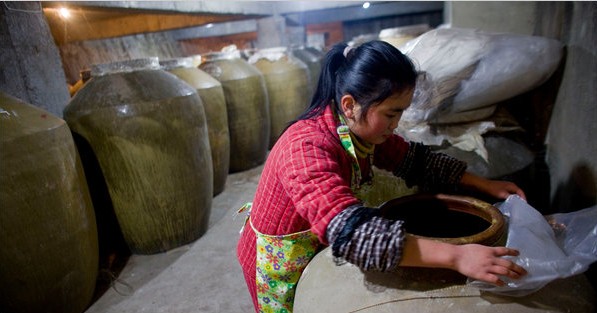
MAOTAI, China — If history is indeed written by the victors, then this isolated mountain hamlet in southern Guizhou Province hit the jackpot when Red Army soldiers sought refuge here in the spring of 1935. Exhausted by their long-distance retreat from Nationalist forces, Mao’s guerrillas used the town’s bracing 144-proof liquor to disinfect wounds, tame diarrhea and take the edge off their jangled nerves.
“The Long March was a success in large part due to Maotai,” the rebel commander Zhou Enlai later told historians. In 1949, after becoming prime minister of the newly established People’s Republic, Mr. Zhou designated the sorghum-based liquor, called Moutai, China’s “national wine,” giving it an undeniable marketing edge over the other gullet-searing grain spirits, collectively known as baijiu, tossed back at banquet tables across the nation.
But when the retail price hit nearly $200 a bottle last month, a 50 percent increase over two years, Chinese drinkers erupted in outrage, accusing the state-owned distillery of discarding its revolutionary roots to gouge the little guy. It did not help when media reports revealed that the same bottle sold for half that much in the United States and Europe.
“I hear most of it gets delivered to Zhongnanhai,” said Wang Yonghui, 32, a bank teller and baijiu aficionado, referring to the Beijing compound that houses the country’s top leaders. “We pay more, and they get it for free.”
Here in Maotai, where the pungent odor of fermenting sorghum is overpowering and almost everyone works for the distillery, spiking prices have become a point of pride.
But the higher prices have increased the ranks of those who traffic in counterfeit Moutai — the name comes from the town’s prerevolutionary spelling — and they, too, are savoring a surge in business.
Despite a national campaign against fake Moutai, the authorities seem to be losing the battle against counterfeiters, who have perfected the look and taste of the real thing. All across town, stores sell Moutai’s distinctive white bottle, and chemical vendors shamelessly hawk additives that can turn run-of-the-mill homemade spirits into liquid gold.
“We can put any label you want on any bottle you want,” bragged Ren Longmei, a taxi driver whose family operates a backyard distillery, as does nearly everyone here. “How much do you want to buy?”
Although company officials blame a shortage of sorghum for the price increase, experts said it had more to do with soaring demand, an outgrowth of China’s sizzling economy, and the arrival of the Lunar New Year on Feb. 3, a holiday during which gift-giving reaches its frenzied peak.
“Moutai has become China’s Louis Vuitton,” said Liu Yuan, general secretary of the National Association for Liquor and Spirits Circulation, a trade group. “Given the limited output and steep price, it’s a good way for officials to curry favor and for the rich to show off their wealth.”
Last month, a 1959 vintage bottle of Moutai sold for $152,000 at auction and a 30-year-old bottle can set you back more than $3,000. The run on supplies has forced official Moutai outlets to institute a strict two-bottle limit.
Yan Changzhou, who sells bona fide Moutai at a factory outlet in Beijing, said stores like his received only 40 bottles a day from the state-run distributor. Lucky buyers must be there when his shop opens at 9 a.m. Supplies, he said, are often gone in minutes. “I get a lot of people screaming at me,” he explained last week as disappointed customers came and quickly left. “The pressure has never been so intense.”
Moutai fans breathlessly cite its revolutionary pedigree and are quick to compare its refinement to Champagne or Scotch. They point out that good Moutai takes a year to ferment and at least four more years to age. “The way its flavor dances on your tongue and tickles your senses is something that other kinds of baijiu cannot match,” said Chen Yu, 38, an insurance company employee and self-described Moutai connoisseur who has already bought six bottles this month, two at a time.
Others, especially Westerners who find themselves trapped at Chinese banquets, might find that charitable: Descriptions like rubbing alcohol and diesel fuel are common. And the spirit’s kick — its alcohol content tops out at 53 percent — is so notorious that White House officials warned President Richard Nixon to avoid the stuff during his 1972 visit to China. “Under no, repeat, no circumstances should the president actually drink from his glass in response to banquet toasts,” Alexander Haig, then an aide to Henry Kissinger, warned in a cable before Mr. Nixon’s arrival.
