Uncorking history(1)


There are only two reasons that you might know about Hong Kong's Crown Wine Cellars - either you are a history buff or a wine lover.
Tucked in the dense foliage of Shouson Hill on Hong Kong Island, on one side of Deep Water Bay Drive, the place is as unheralded today as it was intended to be when it was created. But if you listen to Gregory De'eb, co-founder of the wine cellar, this piece of land is where "all the energy of the island is focused".
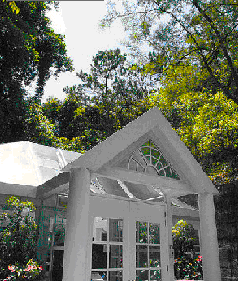
Seven decades ago, what is today Asia's most advanced wine cellar facility was the site of a secret arms and ammunition depot. Comprising 12 pairs of underground bunkers, a depot headquarter and a sentry box, the site was used by the British to store guns and grenades for the defense of Hong Kong. Construction was believed to have started in 1937.
That was the eve of World War II. And according to De'eb, the British military chose the site to keep it a secret.
"There were many Japanese spies in the local communities before the Japanese invasion, and they were very effective from a military point of view," he says. "If the British wanted the location of their ammunition depot to remain a secret, it had to be built in the middle of nowhere".
The local fishing village of Aberdeen is located about 5 km away and is known as "Little Hong Kong" in Cantonese. The British used this version as a "code name" to refer to the military site and thus confuse those spying for the Japanese.
"The Japanese had no clue where 'Little Hong Kong' was. It was, of course, where we are standing right now," says De'eb, during a recent interview at the cellar.
Today, what is best known about the site is that it was the last place to surrender during the Battle of Hong Kong, which lasted 18 days and ended with the British colony being taken by the Japanese army.
