Jess Jackson's legacy(1)


By Nathan Halverson & Kevin McCallum
Sonoma County wine icon structured company to ensure growth, descendants' control
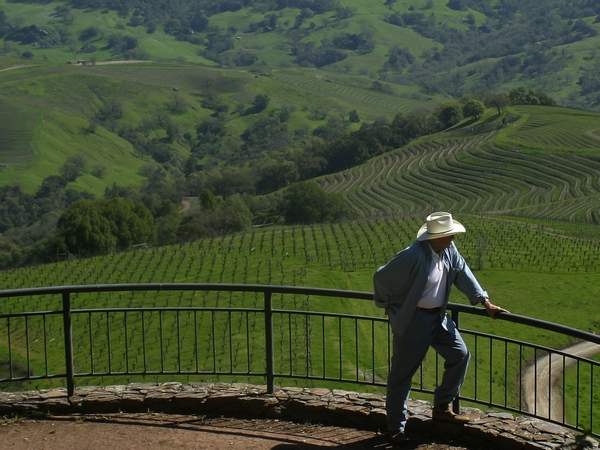
PD File
Jess Jackson looks out over his vast vineyard domain in Sonoma County in 2005.
Jess Jackson, who built one of the world's largest wine companies before his death Thursday, dreamed of creating a family-owned business that would not only survive his passing but thrive in the hands of future generations.
He structured his company, Jackson Family Wines, in a complex web of trusts and other legal entities to ensure it would remain under family control, company executives said Friday.
Now, responsibility for guiding the multibillion-dollar business rests with his wife, Barbara Banke, and his son-in-law, Don Hartford.
“Jess's dream was to build a business he could pass on to his children, and them to their grandchildren,” said Hartford, chief executive of the company. “It's now in Barbara's and my hands to continue that dream.”
The Santa Rosa company will not be broken apart and divided among his children, or sold off to pay debts or inheritance taxes, Hartford and company President Rick Tigner said. Instead, Jackson Family Wines is looking for opportunities to expand.
“Jess has put us in a great position for the next decade,” said Tigner, who has been with the company for more than 20 years. “We're in growth mode.”
Before his death at the age of 81, Jackson created a wine company that employs 1,000 people around the globe, including about 450 in Sonoma County, and operates 35 wineries on four continents. It owns 10,000 acres of vineyards across the world, including 3,000 acres in Sonoma County.
In the final decade of his life, he spent more than $200 million building a horse-breeding and racing operation in Kentucky that became one of the envies of the thoroughbred world.
Even as he assembled his empires in the worlds of wine and horses, Jackson was taking steps to seamlessly pass on his holdings to his heirs.
“When I die, there will be nothing in my name,” Jackson said in a 1995 interview with The Press Democrat.
Across the wine industry, many analysts expect the flagship Kendall-Jackson brand and his other wineries will carry forward without a stumble.
“As a good attorney, and a good pragmatist, he anticipated his death,” said David Freed, chairman of Silverado Premium Partners, a Napa vineyard investment firm. “I think you are going to see a very smooth transition.”
Visionary, micromanager
Jackson was a formidable competitor. He was both a broad visionary, who saw opportunities that others missed, and a detail-minded micromanager, intimately involved in making decisions on everything from wine blends to marketing campaigns. The combination draws comparisons to executives such as Steve Jobs at Apple who have intertwined their personalities so deeply into their companies that they become synonymous.
Now, some wine industry insiders wonder about the company's long-term culture without his presence and the difficulties of keeping family members unified as a corporate team.
Company executives respond that Jackson built his ethos into the structure of the company, maintaining the various wine brands as separate operations with distinct vineyards and managers. These guiding principles will shape decisions and growth for decades, if not centuries, to come, they said.
“What Jess has put in place is a very decentralized group of wineries,” Hartford said. “Jess put in place a structure to last.”
In recent years, Jackson Family Wines has been forced to consolidate its operations as consumer demand for luxury wines dropped following the collapse of Wall Street and the onset of a severe recession. The company moved aggressively to cut costs, laying off about 170 people in early 2009 and closing or ceasing production at several wineries around the state.
But demand for luxury wine is expected to recover as the economy rebounds, and the company is set to expand in response, Tigner and Hartford said in an interview at the company's headquarters near the Charles M. Schulz-Sonoma County Airport.
“We look to go forward and become even stronger,” Hartford said. “And that is a tribute to Jess.
The company is not thinking about what it might sell, but what it might buy, said Tigner, who reports to Hartford and Banke, who is chairwoman of Jackson Family Wines.
Industry analysts agreed that the company is in a strong position.
“Kendall-Jackson is a unique force in our business,” said Robert Nicholson, a winery broker in Healdsburg who specializes in selling and determining the value of wine brands. “Jess and Barbara built a business that stands on its own two feet.”
Analysts estimate the company, which reported selling 5 million cases of wine last year, generated more than $500 million in annual revenue and continued to return strong earnings of nearly $100 million for the Jackson family.
“It's got to be among the more profitable wineries in Sonoma County,” Freed said.
Stables will continue
The company also will continue to operate the prized stables in Kentucky, which are just beginning to produce foals from the award-winning thoroughbreds that Jackson acquired in the last decade of his life.
“That will continue as it has,” Hartford said. “Barbara has become as involved and is as passionate about the business as Jess was.”
Jackson demanded excellence from his executives and had little use for those who didn't meet his expectations.
“People think of him as a tremendously hard-nosed businessman, and he was, sometimes even too tough,” said Pete Scott, the company's chief financial officer from 1990 to 1997. “But he had a golden touch.”
Jackson took gambles with his own money that paid off time and time again, said Scott, who is now a principal in The Vincraft Group in Sonoma.
Jackson's intuitive business sense led him to raise prices while other wineries were dropping prices, and to tighten up operations and reduce costs while others were focused on expanding.
“There was certainly no one better at the game strategically than Jess,” said George Rose, former vice president of corporate communications for the company.
Jackson succeeded in compiling a portfolio of luxury wine brands, letting each winery operate as a distinct brand with its own winemaker and vineyards, while consolidating the back-office functions such as accounting and human resources at the company's headquarters.
“He was a pioneer in acquiring and developing a massive wine business, and kept it private, and wasn't one of the guys who sold out to one of the big companies," said Bill Foley, owner of Foley Family Wines in Sonoma.
Foley, who purchased Sebastiani Winery in 2008 and Chalk Hill Winery last year, is assembling a fast-growing wine empire of his own.
“I'm trying to emulate Jess Jackson. I'm trying to set up my organization like he did,” Foley said.
The big test for Jackson's company will be how it performs in the long run without him.
“You can never replace Jess Jackson. What you can hope to do is get a close second,” said Mario Zepponi, founder of Santa Rosa wine industry consultancy Zepponi & Co.
Former executives of the company said they have confidence in the company's leadership, including Banke, a former land use attorney who once argued before the U.S. Supreme Court, and Hartford and Tigner, who each have two decades of experience working with Jackson.
“The reality is that Barbara Banke is a very capable businesswoman,” said Clay Gregory, who was president of Jackson Family Wines until 2009. “Jackson Family Wines is not going to stray from Jess's vision in the short run.”
Ultimately the company's long-term prospects likely will rest in the hands of Jackson's children. His dream was to provide these future generations a place to work in the vineyards, wineries and even the executive offices.
“I'm building a wine legacy for my children. I want to be an Antinori,'” Jackson said in 1995, referring to the aristocratic Italian wine family that built a wine business that has survived more than 600 years with its members involved in the arts, science and law.
Generational plan
“Jess had a very specific plan on how the assets are controlled by the family, going from generation to generation,” Hartford said. However, he declined to explain exactly how Jackson and Banke structured the company so it will not be broken apart.
Transferring a wine business to the next generation can be a tricky process, however, and Wine Country is replete with stories about wine fortunes lost to feuding heirs, said Jay Silverstein, an accountant at Moss Adams who has expertise in succession planning.
Children often have varying levels of interest and aptitude for running wineries, and avoiding strife among them is key, he said.
“If you're not careful, tension among owners can lead to a decline business,” Silverstein said.
Jackson has been turning over ownership of his vineyards and wineries for years. Silverstein said transferring assets to children and spouses through trusts is a common way for wealthy business owners to not only transition the business to the next generation but lower the estate's tax burden.
Jackson's two children with his first wife, Jane Kendall, are Laura Giron and Jennifer Hartford, who is married to Don Hartford. The company's website lists the sisters as owning La Crema winery in Windsor, the empire's second-largest wine brand and one of its most profitable.
His three children with Banke are Katie Jackson, Julia Jackson and Christopher Jackson.
Katie Jackson, 24, is affiliated with Cambria winery in Santa Maria and works in the communications department at Jackson Family Wines. She has a blog on the website for Cambria, which makes a Katherine's Vineyard chardonnay.
Her younger sister, Julia, also has vineyards on the Central Coast and works in the company's communications department, where she has a blog on the website for Kendall-Jackson winery.
Christopher Jackson, who at 6 feet 4 inches stands even taller than did his robust father, is set to graduate from college this spring and is considering enrolling in graduate school to receive a joint law and business degree.
All three of Jackson and Banke's children graduated from Sonoma Academy High School in Santa Rosa, which the couple helped found.
Now one of Jackson's grandchildren from his first marriage is set to begin next year, adding another generation to his legacy.
“We are here stay,” Hartford said.
