Champagne’s Servants Join the Masters(1)


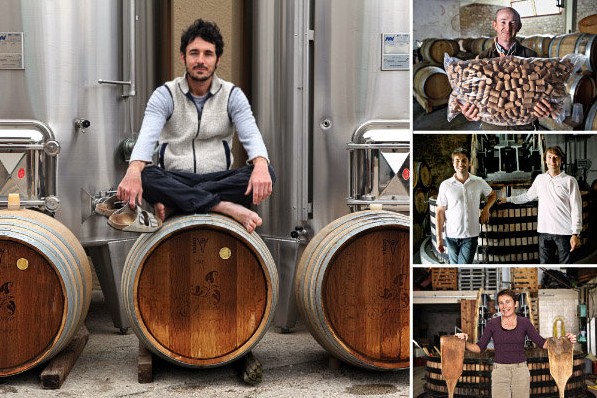
Nigel Dickinson for The New York Times
Clockwise from above: Cédric Bouchard; Bertrand Gautherot of Vouette & Sorbée; Davy Dosnon, left, and Nicolas Laugerotte of Dosnon & Lepage; and Dominique Moreau of Marie-Courtin.
TROYES, France
UNLIKE Reims and Épernay, the Marne cities to the north that are rivaled only by caviar in their close association with Champagne, this pleasant medieval city in the Aube, with its cobblestone streets and timbered architecture, is rarely considered the hub of a thriving Champagne region.
Perhaps that’s because for years the Aube has served anonymously as the workaday supplier of grapes to the production areas to the north, a sort of scullery in the elegant house of bubbly, essential to the smooth operation of Champagne, but best ignored.
Yet today, the spotlight is unexpectedly shining on the Aube, and its primary growing area, the Côte des Bar. Now, the region is coming to be known for its independent vignerons, whose distinctive, highly sought wines have caught the attention of Champagne lovers the world over.
The grandes marques of the Marne made Champagne one of the world’s leading luxury brands by marketing it as an urbane beverage for special occasions. They emphasized the art of blending, in which the distinctions of terroir, grape and vintage are absorbed into a house style.
By contrast, many Aube producers are taking their cues instead from Burgundy, with its emphasis on farming and on being able to trace terroir through the wines. Rather than the hushed pop of the cork and the silken rush of bubbles, these Champagnes suggest soil on the boots and dirt under the fingernails.
Even so, Champagnes from producers like Cédric Bouchard and Vouette & Sorbée, Marie-Courtin and Dosnon & Lepage, Jacques Lassaigne and Drappier, the closest thing to a grande marque in the Aube, can be as ethereal as their siblings to the north, if a trifle idiosyncratic.
“The identity of Champagne has been as a beverage for celebrations, and there’s nothing wrong with that,” said Davy Dosnon, who, with his business partner, Simon-Charles Lepage, issued his first wines in 2007. “But it’s also a wine of terroir, of place, and should be thought of that way as well. And why not in the Côte des Bar?”
The focus on terroir in the Aube reflects a larger discussion throughout the entire region, in which small producers making distinctive, terroir-specific Champagnes from grapes they farm themselves have seized initiative from the big houses. These small grower-producers account for barely an eyedropper’s worth of the Champagne that flows from the region, but they now lay claim to an outsize portion of the fascination among Champagne lovers.
“Before, it was Champagne, singular,” said Michel Drappier of Drappier, the largest and best known producer in the Aube, which was founded in 1808 but didn’t begin to bottle its own wines until the early 20th century. “Now it is Champagnes, plural, as sophisticated and complex as Burgundy, with as many villages, winemakers and styles as any place.”
Mr. Dosnon studied viticulture and enology in Beaune, the heart of Burgundy, and he brings a Burgundian passion for the land to his work. Strolling through a hillside vineyard in the hamlet of Avirey-Lingey, about 25 miles southeast of Troyes, one parcel among 17 acres or so that they farm, I noticed another similarity to Burgundy, tiny fossilized seashells in the earth, like those often seen in the vineyards of Chablis.
Indeed, the Côte des Bar is closer to Chablis than to Épernay, and its limestone and clay soils are more like those of Chablis than the chalky soils to the north. Yet, despite the geological resemblance to Chablis, which makes the most distinctive chardonnay wines in the world, the vast majority of the grapes in the Côte des Bar are pinot noir.
“The soil is also interesting for pinot noir,” Mr. Dosnon said. “There’s a lot of volume and complexity.”
The Dosnon & Lepage Champagnes are superb, especially the 100 percent pinot noir Récolte Noire, powerful yet graceful, wonderfully fresh and aromatic, and a blanc de blancs, Récolte Blanche, a wine of finesse and nuance, with savory, focused floral and mineral flavors.
If the evolution of the Aube seems a bit of a Cinderella story, it’s with good reason. A century ago, in 1911, riots tore through Champagne as, among other issues, the big houses in the Marne tried to exclude the Aube from the Champagne appellation. Eventually, a compromise was reached in which the Aube was granted second-class Champagne status. Even after the Marne finally, if gingerly, embraced the Aube as a full part of Champagne in 1927, none of its vineyards were designated grand cru or even premier cru, marks of quality reserved only for the Marne.
