Utah liquor laws, as mixed up as some drinks(1)


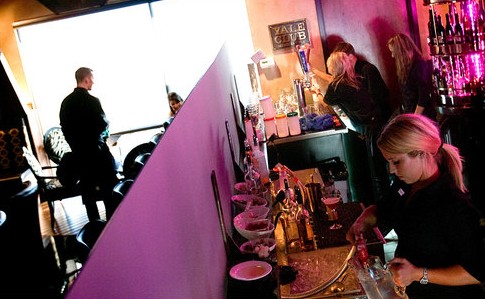
Djamila Grossman for The New York Times
The Vuda Bar, in Utah's Salt Lake Valley, must operate under state laws as a restaurant with alcohol unseen by customers.
DRAPER, Utah — When Vuz Restaurant and Vuda Bar opened here a couple of months ago, the idea was to bring a dash of dining chic to this corner of the Salt Lake Valley.
Diners can watch white-jacketed chefs prepare their risotto in the glass-enclosed kitchen. The lounge area is down a hall dominated by a glass wine cellar. Its centerpiece was to be a shiny bar, with high-end bottles arrayed on circular steel shelves bathed in red, blue and purple lights.
Then the concept ran into Utah’s famously strict liquor laws, which remain unusual even after they were relaxed in 2009 to bring the state more into line with the rest of the nation. Unable to get one of the state’s closely held licenses for its bar, Vuda is now run as a restaurant, which means under current Utah law that drinks can be served but not seen — at least until the customers get them.
So the wine cellar, upon closer inspection, is stacked with empty bottles.
Stools still line the shiny bar in the lounge, but they look straight at a wall of clouded white glass that rises from the middle of the counter, obscuring the bottles and bartenders on the other side.
“Without that license, the patrons cannot see the alcohol and they cannot see the bartenders,” explained James Ables, the restaurant’s manager. “Hence the ‘Zion Curtain.’ ”
It is no longer true that you cannot get a drink in Utah, despite the shot glasses sold in souvenir shops that say “Eat, drink & be merry — tomorrow you may be in Utah.” But the state’s liquor laws — heavily influenced by the Mormon Church, which has its headquarters here and which frowns upon alcohol — are still among the most complex in the country.
Bar owners and restaurateurs complain that the laws, which seem to change every few years, discourage business.
Utah’s liquor laws were relaxed two years ago by Gov. Jon M. Huntsman Jr., a Mormon who went on to be President Obama’s ambassador to China and who is now seeking the Republican presidential nomination. Mr. Huntsman ended the old system in which would-be drinkers had to pay fees to become “members” of bars, which were considered private clubs.
Utah’s bar scene has flourished since then, from the martini bars of Salt Lake City to microbreweries selling beers like Provo Girl Pilsner to the slick après ski clubs in the resort areas. The High West Distillery and Saloon in Park City bills itself as “the world’s first and only ski-in gastro-distillery.”
This month a law took effect banning drink specials. Happy hours have long been illegal here, but many bars adapted by offering all-day drink specials. After the specials were banned, the Utah Hospitality Association, which represents club owners, sued to try to restore them.
“Business has slowed down,” complained Bridget Gordon, the owner of the Green Pig Pub in downtown Salt Lake City, which used to draw customers with $2 drafts on Mondays, $2 Coronas on Fridays and $2 Bloody Marys on Sundays. “Now you can’t do that. You have to do an everyday price, and that’s it.”
