Wine exports wither on vine but there's light at end of funnel(1)


|
Source: www.wineaustralia.com.au |
There is a glimmer of hope for the hungover wine industry as China threatens to do for premium wines what it has done for Australia's resource sector, writes Colin Kruger.
This was meant to be the year Australia's wine industry finally hit rock bottom and started looking up again.
That was before our dollar rocketed to $US1.07, and a projected 1.3 million tonne grape crush - the fruit of recent attempts to curb chronic oversupply - gushed to more than 1.6 million tonnes this year.
Instead the industry faces another year of crippling glut and a currency that is the financial ruin of most wine exporters. The flipside of the currency strength also means imported wines are competing at unprecedented prices in a tough local market.
But amid the woe there has been a bright spot, a glowing ember in the dark promising to set the industry alight.
While wine exports to our two biggest markets, Britain and the US, plummeted, China's imports boomed.
Bottled wine imports from Australia grew 32 per cent in value for June compared to the prior year, while the British and US markets dropped 33 per cent and 20 per cent respectively.
And it only tells half the story.
''China is Australia's largest export market for wine over $10 a litre,'' says Lucy Anderson Wine Australia's director for Asia. ''It surprises people every time I tell them,'' she says.
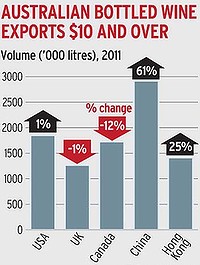
According to the June export data released by Wine Australia, Chinese imports in the $10-plus category almost equalled that of the US and British markets combined.
This figure does not include Hong Kong which managed to import more wine in this price bracket than the entire British market.
More importantly, most of the growth for China came in the $20 to $50 price bracket which more than doubled from June last year.
Wine Australia, the Australian government sponsored promoter, is responding to these changes. Anderson moved office from Adelaide to Hong Kong last year and now employs three staff in China.
It isn't the only evidence that China is doing for the premium wine market what it has done for commodities across the board.
Sandy Mayo global brand manager for Penfolds at Foster's spin-off, Treasury Wine Estates, said that China's demand is driving up prices for the company's premier wine brand across the board - not just Grange.
''The demand is constantly increasing and it outweighs what we are able to supply,'' says Mayo who admits Treasury Wine is still in the early stages of quantifying demand and growth in China. ''There are the core wines such as Grange, Bin 707, Bin 389, Bin 407 that are a focus, but it is not these wines alone. The demand is stretching from Bin 28 right through to Grange,'' she says.
The coronation of China's new status in the Penfolds world takes place in November. For the first time in nearly half a century, Penfolds will release a Bin 620 - a drop considered so exceptional its price will match that of Penfolds' flagship label Grange. The global launch will be held in China.
''We have not done a launch like this in China before. It is a first and a step change for us,'' says Mayo.
Interest is extending beyond the bottle. China's Bright Foods was recently forced to deny speculation it was preparing a bid for Treasury Wine. Late last year Hong Kong-based CK Life Sciences International acquired a controlling stake in Challenger Wine Trust.
South Australian wine industry brokers, Gaetjens Langley, have opened an office in Guangzhou, China to cater to Chinese interests snapping up Australian winemakers and vineyards.
Australia is not even at the epicentre of this China boom.
In France it has become known as the Bordeaux Bubble. The combined appetites of China and Hong Kong make them the largest international market for Bordeaux wines and it has sent prices skyrocketing for the region's Premier Grand Crus.
Last year Hong Kong replaced the US as the world's most important market for fine wine auctions. This year auctioneers Christie's sold bottles of Chateau Latour 2009 for �1870 ($2482), three times last year's price.
British-based Wine exchange Liv-ex reported that the prices of top-end bordeaux last year outperformed gold, oil and Britain's stock exchange.
Influential wine critic, Robert Parker, warned of a speculative bubble in bordeaux prices and warned the region is in danger of pricing itself out of traditional markets as it chases wealthy Asian clientele.
To understand the middle kingdom's dizzying ascent in the wine world it pays to put their buying in a different context.
China's nouveau riche are buying premium wines in much the manner they do other luxury brands, according to a report from Asian investment group CLSA.
''Success, wealth and fame/social standing are highly regarded in Chinese culture and displaying this through watches, jewellery, apparel, cars and wine garners respect,'' says the report which forecasts that China will account for 44 per cent of luxury goods sales globally by 2020, up from 15 per cent today.
CLSA says these new, young and wealthy elite are willing to pay a premium for goods with cache, ''a trend that is noticeable in the wine sector where fine wine prices increased 40 per cent during 2010''.
The fact that the premium market is driven more by prestige than palate means there is no imminent danger of a wine bubble developing for producers who are not at this gilded end of the market.
This is the sober reality for the 99 per cent of the market not considered ''investment grade'', according to Sam Gleave of Bordeaux Index a European fine wine merchant with offices in London and Hong Kong.
''The only thing that really affects prices at the mass-produced end of the market is exchange rates,'' he told the Guardian last month.
It accurately reflects the predicament of most of Australia's export market built on ''sunshine in a bottle at $4.99'' as industry veteran Kevin McLintock puts it.
Even in China, the pickings get rather slim once you leave the realms of the super wines.
Neil McGuigan, chief executive of Australian Vintage says the Chinese want to buy premium and they want to buy entry level. In simple terms it's ''what's your best and what's your cheapest'', he says.
With the dollar putting a strong wind behind Australia's new world wine competitors such as New Zealand and Chile, Australia can no longer afford to play in this end of the market.
McLintock, who headed the taskforce which developed Directions to 2025 - a blueprint for the industry's future based on driving Australian wines up the value chain - knows better than most the challenges facing the industry as a whole.
