Next stop, Nanjing(1)


As a travel destination, Nanjing is often overlooked in favour of cultural Beijing and commercial Shanghai. But Nanjing - literally "southern capital" - has always held an important place in Chinese history.
It was a pivotal city during the Three Kingdoms period and remained an important place throughout the different dynasties as a textile hub before the first emperor of the Ming Dynasty, Hongwu, made it the capital.
It was also during this time that the city gained its structure as Hongwu ordered the construction of city walls. The 600-year-old and counting walls still stand, making it the most ancient city walls in the world, according to the UNESCO World Heritage Centre.
The city also entered the annals of history as the site of the horrific Nanking Massacre. But from the ashes of history and destruction, Nanjing has rebuilt itself into a cosmopolitan, fast-developing metropolis while retaining its pretty, historical landscape.
A sense of history
 As one of the Four Great Ancient Capitals of China (the other three are Beijing, Luoyang and Xian), Nanjing served as the capital for six dynasties. It is perhaps no surprise that one of China's biggest museums holding great treasures of the past is located here.
Taking up a space of 70,000 sq m, Nanjing Museum has a collection of more than 400,000 artefacts, ranging from ancient bronze and jade items, to calligraphy and paintings from various dynasties, to Ming and Qing porcelain. Other exhibits include collections of folk art, silk from the Jiangnan region, as well as contemporary art.
Nanjing's warring history can be seen at the Nanjing City Wall and its southern Zhong Hua Gate. Built in the 14th century, they were a key part of the city's defence during ancient times.
The Tai Ping Kingdom History Museum, which commemorates the short-lived rebellion against the Qing dynasty and feudalistic system in 1851 to 1864, and the Nanjing Massacre Memorial Hall, which documents the World War II massacre, are records of the city's tumultuous past.
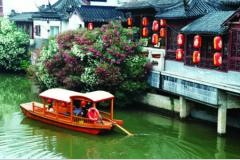
To get a taste of how life might have been in the grand dynastic era, head to the Qin Huai River, which branches off from the famous Yangtze River. This was the birthplace of old Nanjing culture and it was a centre for the leisurely pursuits of aristocrats, artists and scholars who gathered along the river banks.
Although the river fell into disrepute following the wars which destroyed many buildings and left the river polluted, a massive restoration project which began in 1985 has turned things around.
Today, buildings along the sides of the now-clean river have been re-constructed in the traditional Ming and Qing architectural style, evoking memories of ancient Nanjing. Take it all in on a river cruise in a traditional boat, which is especially pretty when the river lights come on at night.
One of the highlights along the Qin Huai River is the Confucius Temple (Fu Zi Miao). The temple is a tribute to the ancient Chinese philosopher whose thoughts formed the underlying basis of Chinese society, and whose impact stretched beyond Chinese shores to influence the development of Japanese, Korean and Vietnamese cultures as well.
Signs of modern times
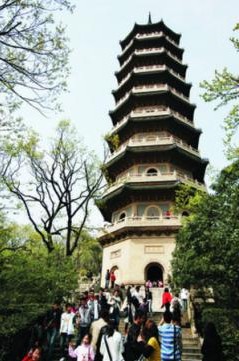 But what would Confucius say if he found out that the area around his temple is now filled with blatant consumerism? Tea houses and small stalls selling local food and knick-knacks are set within the buildings, and fast-food chains and small fashion outlets have also appeared nearby.
It seems that Nanjing can't wait to embrace its vibrant, dynamic and modern side. If the Confucius Temple area is a great shopping spot for small local items, then Xin Jie Kou, Nanjing's dazzling commercial and shopping district, is the place to go for modern retail finds.
In department stores and mega complexes such as Deji Plaza and Golden Eagle Shopping Centre, you can find anything from major global chains like Walmart and Watsons, to high-end brands Gucci and Fendi.
