China comes to Thailand(1)


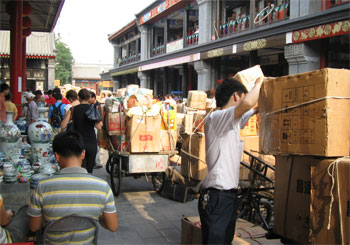
All the tea in China
As Beijing’s clout grows, some Thais are uneasy
There is perhaps nowhere in Southeast Asia where the growing influence of China – economically, militarily and diplomatically – is being felt more than in Thailand, long one of the United States’ most steadfast regional allies.
Concern about China’s growing role cropped up recently at a Bangkok birthday party where the dinner guests were bubbling with cheer until the subject of China came up, causing some of the Thais at the party to suddenly turn gloomy.
“People in Thailand are worried," said a former foreign ministry diplomat, placing down his glass of red wine. "China's economy is so big, and ours is so small, that we cannot compete with all the Chinese things being sold here. It is especially a problem for Thai SMEs,” small and medium-sized enterprises.
"China will own us," said an interpreter for top government leaders, expressing her concern at Beijing's rapidly growing influence on Bangkok's economy. "Of course China will also own America, but your economy is so big you can just tell Beijing that you won't pay all the money you owe, and they can't do anything about it. But Thailand is small. We can't say no to Beijing. Thailand will be like a vassal of China,”
The birthday party attendants aren’t alone. US corporations are also fretting about how to compete in a region where the shared knowledge of Chinese dialects and an ancient heritage, give China unique advantages over America. Much of Thailand’s political and business elite are ethnic Chinese. China's ability to sell food, household goods and other items at lower prices than even Thai manufacturers has also pleased customers in this Southeast Asian nation while imperiling manufacturers.
Beijing is simultaneously increasing its military and cultural influence in Thailand, trying to wean Bangkok away from Washington and other foreign governments while expanding China's own reach southward.
As with the Chinese diaspora across Southeast Asia, migrants have been settling in Thailand for generations, arriving through Laos and across the Mekong River or, more often, by sea from China's southeast coastal towns to Bangkok. The earliest arrivals melded into a relatively unpopulated land centuries ago, maintaining some Chinese roots while mixing with ethnic Mon, Shan, Khmer and Thais to produce offspring who are today generally called Sino-Thais.
During the 1950s and 60s, Chinese also fled the Communist takeover of their country, seeking greater freedom, safety and a capitalist economy in Thailand. Some of the Chinese where suspected -- rightly or wrongly -- of being communist infiltrators and were arrested, imprisoned or shot dead by Thailand's US-backed military which supported America's Vietnam War and believed in Washington's "domino theory" of communist expansion across the region.
Many of the Chinese who survived, however, advanced upward and their descendants now occupy some of Thailand's highest political, economic, military and cultural positions. Today, Chinese faces, fashions and symbols are promoted in Thai advertisements and pop culture as badges of financial success. Many Thais admire local Chinese for educating their kids in Thailand's private "Chinese schools" while keeping their families united and working hard as a business team.
Yingluck Shinawatra, scheduled to be installed as the country's first female prime minister in August, appears eager to allow China to construct high-speed trains on five main routes across Thailand, replacing the country's decrepit, accident-prone railway. The first 380-mile (615-km) Chinese rail line would link Bangkok and Thailand's northern border town of Nong Khai, where a railway bridge over the Mekong River already leads to Vientiane, the capital of Laos.
The Chinese railway projects could take a decade or more to complete, and sources say there is considerable opposition to them that could keep them stalled for quite some time – precisely because of concern about Thailand's integration with China, but also because the collision in China on July 24 of two bullet trains, which killed at least 39 people, has raised questions among some Thais about Beijing's ability to build safe trains. The projects are extensive. Thailand’s railway tracks won’t handle super-fast trains, so entirely new roadbeds will have to be laid. Chinese officials are beginning to discover that the roadbeds for their own high-speed rail projects are substandard in many areas, and will have to be redone.
In January, Chinese investors began building a huge U$$1.5 billion China City Complex near Bangkok which its promoters say could employ more than 70,000 Chinese citizens. They would be able to import parts from China, manufacture the items into finished products on Thai territory, and export them elsewhere as "made-in-Thailand" without suffering some of the expensive tariffs which made-in-China products must pay. The Chinese will also be able to sell the 700,000-sq-meter complex's clothing, household items and other goods to people within Thailand, free of tariffs.
"Apart from the business opportunities in Thailand, Chinese exporters can also promote their products to developed markets such as the European Union and the United States through this project," said Yang Fangshu, chairman of the ASEAN-China Economic and Trade Promotion Center, according to Beijing's China Daily.
In 2006, when Thailand's military staged a coup and toppled the prime minister, Washington suspended US$24 million in military assistance and restricted high-level meetings.
Beijing, however, described the coup as Bangkok's internal affair and gave $49 million in military aid and credits to Thailand, while increasing the number of exchange students at both countries' staff colleges, and convincing the Thai military to participate in yearly, small-scale Special Forces joint exercises.
Chinese and Thai special forces held a 15-day joint anti-terrorism drill, "Strike-2010," during October in China's southern Guilin city to practice shooting, assaults and strategy. During the same month, more than 100 troops and officers from the China Marine Corps' amphibious special warfare unit participated in a 10-day "Blue Strike-2010" drill with their Thai counterparts, using light weapons, underwater combat equipment, amphibious reconnaissance and anti-terrorism equipment.
