Changyu's uniquely individual approach to wine production(2)


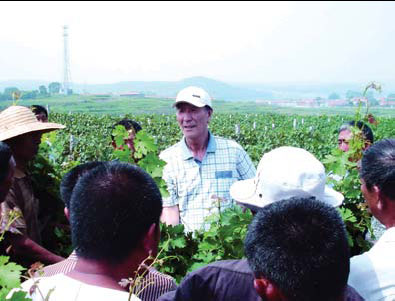
Specialist providing on-site training to grape growers.
One example of this is Yao Yilin, a 31-year-old farmer in Daliuhang, a town near Yantai, who has made a small fortune from growing grapes for Changyu.
In 2006, Yao signed a contract with Changyu to grow grapes on a 7.5-hectare piece of land. Last year, he took in more than 200,000 yuan ($31,040), several dozen times the salary he would get from working in a factory. This year, he expects to earn 300,000 yuan.
To improve the quality of grapes, Changyu uses a range of technicians: six of them are China's leading grape experts, and there are at least 200 others with professional experience, as well as 100 postgraduate agronomists.
These people are responsible for both management and technical services and they provide regular training for the growers.
"Every day, I have to walk around the vineyard to check on growing conditions of each and every vine, and deal with any problems the growers have," said Zhou Xinming, a postgraduate major in vineyards and wine production, who has worked at Daliuhang for four years.
The growers are all provided with the same seedlings, fertilizer, and pesticides to ensure grape quality and uniformity. The company also has an information management system for every planter to give information on when and how and how much fertilizer or pesticide to use.
"We plant our grapes according to strict standards. To ensure the quality of our wines, we only raise around 250 vines per mu, and the grapes from each vine are only be used to produce one bottle of premium wine," Li commented.
Changyu has also teamed up with the International Finance Corp, a member of the World Bank Group, to do research on disease prevention and pest control. Before it buys the grapes, the company has random samples taken from all the vineyards and sent to its technical center where they are closely checked against 50 food safety and quality standards. Only those that meet all the standards qualify for wine production.
Going global
Changyu plants its distinctive varieties of grapes in accordance with the different natural conditions found in all of China's top grape-producing areas.
Every vineyard has a fermentation plant or chateau beside it to make sure that the grapes are sent to fermentation tanks within one hour of picking.
Yantai is now the only international vineyard and wine city in Asia, with a 20-hectare vineyard of fine grapes that have been selected for a special Changyu dry red. The vineyard is only allowed to produce 150 tons of premium grapes, or just enough for 60,000 bottles, and no more, of top-level wine annually.
"The wine has very rare, cellar flavor - smooth and round with a very long after taste. Only top, time-honored red wines can give this kind of feeling," commented Robert Tinlot, an honorary president of the French Wine University, after sampling a glass of century cellar dry red.
Thanks to its quality, Changyu's wine is often served at state banquets and summit meetings, such as the opening ceremony of the Shanghai World Expo last year, and the welcoming banquet of the BRICS summit China, in Hainan this past April.
It has also been exported to about 28 countries, including Germany, Italy, and France. It can also be found in more than 3,000 supermarkets, shops, and five-star hotels across Europe, and even in the first-class cabins of Germany's Lufthansa Airline.
An increasing number of prominent people overseas have found themselves attracted to Changyu's wine taste and have even begun to collect it. Warren Buffett, for example, the maverick American investor, has taken Changyu wines and picked up a bottle of century cellar dry red during his visit to Beijing last year.
Other big collectors include former US president Bill Clinton, Jack Welch, former CEO of General Electric, and Fukuda Tasuo, former Japanese premier.
"All of these people indicate that Changyu is convincing people that its wines can rival the top wines in the world," Li said, with obvious pride and confidence.
