Haute Cuisine's Makeover(1)


'Fun' Is Replacing 'Fine,' Comprehensive Culinary Study Finds
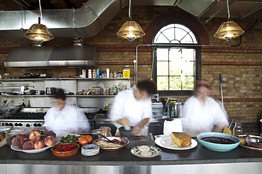
Dock Kitchen
Preparing the meal at Stevie Parle's Dock Kitchen in West London.
Until the past decade, the Connaught Grill in Mayfair, London, was perhaps the most traditional haute-cuisine establishment to be found anywhere. Chef Michel Bourdin, who held two Michelin stars for more than two decades, openly professed his model to be the great Auguste Escoffier, who made his mark a century earlier.
Not only were there 50 people in the kitchens, hors d'oeuvres trolleys and potatoes cooked eight different ways, but they also employed their own butcher to ensure every cut was perfect. After the main courses were consumed, staff deftly held each piece of cutlery, crockery and table decoration above the surface, while two others rolled a perfectly ironed linen tablecloth over the existing one to ensure an immaculate backdrop for the grand finale of desserts.
What a difference a decade makes. Since Monsieur Bourdin retired to the South of France in 2001, two celebrity chefs—Angela Hartnett and Hélène Darroze—have made their mark at the Connaught, and that era, with its links stretching back to the 19th century, has now entirely vanished.
What is the current state of the gastronomic industry now that cookery programs vie with reality shows for top ratings and chefs are international celebrities? For the first time, a global survey evaluated food trends, relying on 70 anonymous food writers and critics associated with the San Pellegrino Top 50 Restaurant Awards. The survey posed 125 questions in 15 different categories, ranging from cooking styles and techniques to presentation, service concepts and produce selection.
The survey concluded that "local" is the "new global"; that there is a strong trend toward "fun dining" over "fine dining"; that foraging will grow even more important; and that certain dishes, such as glazed pork belly, are the new standard international dishes.
Local sourcing is now almost a cult, along with the profusion of information about everything served on the table. However, such terms as regional or local can be deceptive. On a recent visit to Copenhagen's Noma, which is the flagship for Nordic Cuisine, exquisite langoustines arrived at the rear of the restaurant from Trondheim in Northern Norway, more than 1,000 kilometers away.
Interestingly, the overall conclusions of the survey only apply to established regions of fine dining. In emerging markets and countries such as India, Brazil, China and Russia, the old-fashioned approach still rules. "Traditional luxury and bling is on the rise in developing markets—on the plates as well as all around them—while more mature and sophisticated markets are moving in the opposite direction towards a new simplicity," the report said.
Another interesting conclusion was that Modernist Cuisine—the variety of culinary tricks as perfected by elBulli in Spain and the Fat Duck in Britain—is virtually dead, although techniques such as sous-vide or low-temperature cooking, have entered the mainstream.
Lars Peder Hedberg, the survey's author, said "The first thing that surprised me is that there were so many similarities between many places. If you look at what is going on in South Africa, Australia, Scandinavia and parts of the U.S., you will find almost identical trend patterns."
