Sunrise Foods Tofu(1)


Celebrating Canadian Growers and Producers at Calgary Co-op
Celebrating Canadian Growers and Producers at Calgary Co-op
Photograph by: Left Getty Images, Calgary Herald
How a backroom operation in Vancouver grew into Canada'slargest producer of tofu. by Julie Van Rosendaal
There is perhaps no other food as widely ridiculed as tofu. It struggles to shake its stigma as bland '60s hippie fare-and yet we've come to accept, even embrace, yogurt and granola, which were equally trendy new health foods at the same time the perfect white-meat substitute arrived on the scene.
Of Chinese origin, tofu plays asignificant role in Southeast Asian cuisine, and is becoming more accepted in North America as a low-fat and inexpensive vegan source of protein. Made by coagulating soy milk (itself produced by soaking, grinding, boiling and straining soybeans) and pressing the resulting curds into blocks, tofu is available in various forms, its texture ranging from soft custard to firm-cooked eggs depending on its moisture level. Tofu is creamy (though some might describe it as rubbery) with a mellow flavour, making it infinitely adaptable in the kitchen from main courses to desserts.
One of the most recognizable Canadian producers of tofu is Sunrise Soya Foods. It began as a one-man operation in 1956 when founder Leslie Joe and his wife Susan, newly immigrated from China, recognized a demand for tofu in the Chinese community of Vancouver. Owners of the bustling Sunrise Market, still a well-known hub of good food and fresh produce in Vancouver's Gastown district, Leslie and Susan began making small batches of tofu from scratch in the backroom. Their tiny operation flourished in the '60s and '70s, when tofu was relatively new to the Western diet and popular only among vegetarians and the health-conscious.
The first packaged Sunrise tofu products became available at supermarket chains across Western Canada in 1985. In 1999, Sunrise became one of the first companies to promise exclusively non-GMO (genetically modified organisms) in its products- from the soybeans themselves to any added ingredients. Today, Sunrise has grown from a one-man operation to the largest producer of tofu in the country, employing over 200 Canadians. Leslie and Susan's son Peter Joe, who learned how to make tofu as a teenager working in his parents' shop, is now at the helm of the operation. Little did he know when he carted buckets of tofu around Vancouver's Chinatown in the 1950s that his family would evolve into a Canadian success story.
Tofu is more versatile than it's often given credit for. Much like yogurt, it's creamy enough to be whizzed into sauces, soups and smoothies, mellow enough to make the base for a creamy chocolate mousse (no one will be able to tell!) and yet sturdy enough to toss on the grill.
Its mild flavour and soft texture allow tofu to absorb seasonings well, so you can marinate it, douse it in barbecue sauce or use your favourite rub before cutting it into slabs. As with meats, vegetables and fruit, grilling tofu imparts a smokiness and crusty exterior that may just reform those who don't care for it because of its otherwise soft texture. Looking for another way to get past tofu's texture issue? Just whiz it into a smoothie, creamy peanut sauce or chocolate mousse.
CRISPY GRILLED TOFU
Set a brick of firm tofu on top of a double layer of paper towels; top with another double layer and set a cast iron skillet or other weight on top. Let stand for 10 minutes to press out any excess liquid. Cut the tofu crosswise into 6-8 slices and place in a shallow bowl. Whisk together 1/4 cup soy sauce, 2 tbsp brown sugar, 2 tsp grated fresh ginger,2crushed garlic cloves, a drizzle of sesame oil and pinch of red-pepper flakes and pour over the tofu; let marinate for 10-20 minutes, turning once or twice. Remove the tofu from its marinade and cook on a preheated oiled grill until golden and char-marked on both sides. (Alternatively,cook in a drizzle of oil in a hot skillet until golden and crisp on both sides.)
CREAMY TOFU CHOCOLATE MOUSSE (REALLY!)
Melt 8 oz (250 g) dark or semi-sweet chocolate in the microwave or in a glass or stainless steel bowl set over simmering water.Cool slightly.Inthe bowl of a food processor,purée the melted chocolate with a package of soft tofu and a teaspoon of vanilla until smooth. If you like, add a ripe banana, broken into chunks, or 1/4 cup of smooth peanut butter.Pour into individual dishes to serve.
CREAMY TOFU PEANUT SAUCE
In the bowl of a blender or food processor pulse 1 pkg soft or silken tofu with 1/2 cup peanut butter,2tbsp each brown sugar,rice vinegar and soy sauce, 1 garlic clove and 1 tsp grated fresh ginger.Ifyou like, add a dab of curry paste, a drizzle sesame oil and/or a capful of coconut extract. Puree until smooth and keep in the fridge to toss with noodles or serve with chicken or pork satay, cooked shrimp, rice-paper rolls or potstickers.
BLUEBERRY&WATERMELON TOFU SMOOTHIE
Whiz chunks of watermelon and a few handfuls of blueberries with a package of soft or silken tofu, or try sweetened fruit-flavoured tofu. The water content of the melon should be enough to make it sippable-add more melon or juice if it'stoo thick.
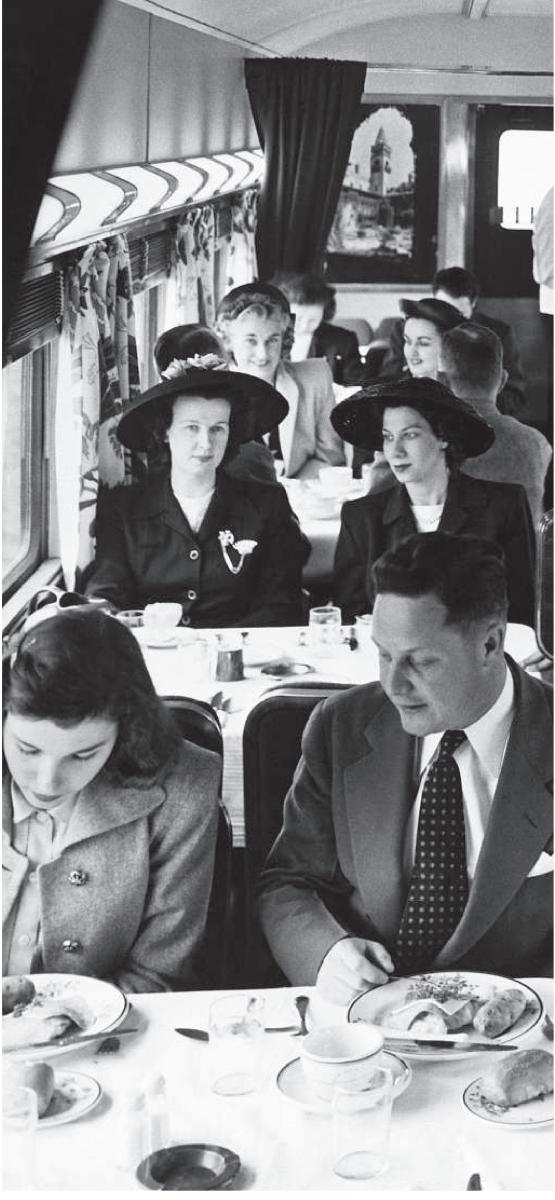
Taking the Mountaineer from Vancouver to Calgary, or vice versa- seated high in double-decker, glass-domed coaches, like CN's Sceneramic cars from the '60s-is not third-class. It's a slow-travel throwback to the luxury rail tourism of Sir William Cornelius VanHorne,wherepassengers are doted on, fed scrambled eggs with smoked steelhead, and plied with wine and single-malt scotch. For those who can afford it, the Mountaineer gives a grand tour of the West, from the cranberry bogs of the Fraser Valley to the postcard-a-minute scenery of the Rockies.But this is a boutique, bucket-list sort of train trip,adomestic passage made exotic by the service, and by the premium price.
I took the same trip at age 12 from Vancouver to Banff on The Canadian-a VIA route that still runs west to east, though it now skips Banff and Calgary in favour of Jasper and Edmonton. I enjoyed it almost as much as my time on the Mountaineer,eventhough the feature dessert was asquareofMcCain's Deep and Delicious frozen chocolate cake,recently thawed and popped out of the foil pan. Gourmet meals a renot essential to train travel; even taking a commuter train like GO Transit in southern Ontario is a little vacation from highway gridlock, where you can drink your coffee,read a magazine and cast philosophical glances at the landscape.But whether it'saregional commuter or the Rocky Mountaineer,aride on a train in Canada leaves you wondering: what happened to rail travel here, and why can't we have more of it?
Why Canada is "not even in the game"
When looking at the future of rail in Canada, it'shelpful- and a bit startling-to compare ourselves with other countries. Rail travel is a nostalgic holdover for most Canadians, rather than a preferred and highly modern mode of transit, as it is in Europe and Asia. Countries like France, Spain, Japan and China have put big money into expanding passenger rail in the past 50 years, but in North America train ridership has dwindled since the Second World War. Compared to the rest of the world, we look railphobic. The average person in France travels 1,350 kilometres by rail each year; in tiny, well-oiled Switzerland (wherealate-running train could bring down a government) citizens travel an average of 2,350 kilometres by rail annually. And in Japan, home of the Shinkansen bullet train and the first country to build dedicated high-speed rail (HSR) tracks,the national average is the world's highest at 3,100 kilometres per person.
Americans, in contrast, ride the rails an average of 120 kilometres per year-a number boosted by travellers on the continent'sonly high-speed rail line, the Amtrak Acela Express which runs between Washington D.C. and New York City.InCanada, we don't have a single HSR line and-unlike in the U.S.,whereearlier this year President Obama announced $53 billion in funding over six years to spark the creation of new HSR lines-wehaveno federal leadership or policy on passenger rail. We average about 27 passenger-kilometres each per year, less than one-quarter of the U.S. average and one-hundredth that of Japan. "It's not as if Canada and America are third or fifth in the world or anything like that," said former diplomat Raymond Chretien, representing Quebec at a session on North American high-speed
rail partnerships in June. "We'renot even in the game."
History has not been on the side of rail enthusiasts on this continent, at least not for the past 70 years. Canada and the U.S. subsidized massive nation-building railroad projects in the 19th and early 20th centuries, handing out millions of dollars in taxpayer-funded bonds and land grants; but in the '50s, subsidies in North America shifted from railroads to building airport runways and massive road projects like the Trans-Canada Highway (started in 1950 and finished in 1971). Cars and trucks became the standard for hauling people and freight short distances between cities; planes took over for long-distance trips.The U.S. once had over 610,000 kilometres of freight and passenger track, but now has only 230,000 kilometres.Canada has about one-quarter of that, close to 50,000 kilometres.
Passenger rail service,particularly out West, is sparse.Since VIA Rail's service to Calgary was severed in 1990 the Rocky Mountaineer is the last remaining passenger train serving the city.InAlberta you can still ride the old VIA Super Continental route as far west or east as you care to go-or forthatmatter,take a left at Winnipeg and head due north to Churchill- butfirstyou have to get to Edmonton. This guarantees very few Calgarians will ever ride it. A Crown corporation formed in the late '70s,VIA Rail is, like Amtrak, a vestigial but tenacious entity that has managed to keep passenger rail alive, handling about 93 percent of all such trips in Canada.
Traditional passenger trains of the sort provided by VIA are unlikely to make a major comeback here. You can blame the wide-open spaces between our cities, which make air travel faster and cheaper-and you can partly blame the fact that we don't own our own tracks. Canadian railway infrastructure is owned by freight providers Canadian Pacific Railway(CPR) and Canadian National Railways, among others, who are not always keen to share the steel ribbon. "We have a fundamental flawinCanada that they don't have in Europe: we privatized our rails," says Paul Langan, of High Speed Rail Canada (HSRC), an Ontario-based non-profit advocacy group. "Traditionally in Canada the freight-rail companies see passenger-rail trains as a hindrance, and when we lost control of our rails, we lost a lot of our ability to determine our transportation future." When passenger rail shares track with freight, freight takes priority,whichmeans that travellers are often shunted off to a siding rail and kept at a standstill to allow cargo trains to pass. This can be part of the lazy charm of a scenic two-day tour like the Rocky Mountaineer,but it'saserious impediment to a functional system of national passenger rail.
The return of rail in the form of an electric bullet
We can hope that slow-travel trains will find the ridership to keep themselves going. But if we see a rail renaissance in our lives it will likely happen via the new generation of HSR trains that run at speeds of 220-320 km/h on dedicated, non-freight tracks. Between cities 200 to 1,000 kilometres apart-like Calgary and Edmonton, Vancouver and Seattle,orLos Angeles and San Francisco-high-speed rail can compete with cars and airplanes on the two fronts that matter most to travellers: time and price. High-speed rail blends the kinetic, eye-level pleasures of rail travel with the speeds of small aircraft. When you factor in all the delays of air travel, from security and boarding lineups at airports to the taxi or car commutes required to get to them, time is on the side of high-speed trains,atleast for trips of a thousand kilometres or less. A French TGV can travel the 1,067 kilometres from Calais to Marseille (the same distance from Calgary to Vancouver) in 3 hours and 29 minutes.
For a North American comparison of train versus plane,say you wanted to get from Washington D.C. to New York City. In mid-July of this year you could have taken an economy-class morning flight from Dulles to JFK-a driving distance of about 375 kilometres-for $95 on JetBlue. The flight itself takes an hour and 15 minutes, but you can add at least two hours to that for commuting to and from the airport, check-in, security screens and other airport-based impedimenta. A business-class earlymorning trip on the Acela Express, on the other hand, costs $139, and offers a cafe car, a"quiet car" and a Wi-Fi, and lands you at Penn Station in midtown Manhattan in two hours and 45 minutes.
