Overcoming cold-climate challenges(1)


Part II of a series about short-season viticulture in cool to cold climates
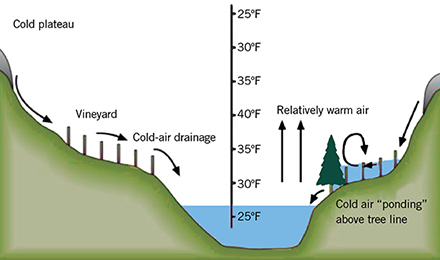
Illustration of local elevation effects on air drainage. Source: Tony Wolf, Virginia Tech
In the first part of this series (“Grape Varieties for Cold Climates,” Wines & Vines, August 2011 issue), we discussed how cool or cold climates can be defined and looked at some of the varietals that can be grown in these challenging areas. This article will address some of the problems faced by grapegrowers in cold climates.
Winter injury and frost damage
In cold areas, winter injury gets the most attention because of the threat of vine injury or death. This is a well-placed concern, but frost damage should be hard on its heels. Frost risk should be accurately assessed and every possible passive prevention measure employed, most of them related to site characteristics.
As frost becomes a greater concern, so does the date of bud break for all varieties. If frost is a regular threat, varieties with later bud break become the more obvious choice. Chardonnay, for example, is frequently implicated by growers to be at high risk for frost damage.
The economic, viticultural and wine quality complications raised by the loss of primary shoots are very significant and the cause for much anxiety—not to mention loss of sleep. While nature has designed a vine with multiple safeguards (the compound bud) against the hazards of frost and freeze, growers face yet another viticultural conundrum: early bud break and risk of frost vs. the benefits of a longer growing season.
Active frost prevention measures such as overhead sprinklers and wind machines are, quite frankly, too expensive for most of our small vineyards, and they only work effectively under certain conditions. Recent research in Ontario has demonstrated the ability of wind machines to prevent both frost and freeze damage, and they have become the active protection measure of choice. Helicopters utilize the same principle of mixing warm air with cold, but growers have told me that it is hard to find pilots who are reliable and willing to fly at night. However, if a skilled and reliable service can be found, this can be a great tool against frost and freeze events.
When considering the expense of active measures, use the value of the grapes and/or wine against the cost of the equipment or service. In our region, we usually have only one or two serious frost nights and likewise for winter freeze events—of course, it only takes one to ruin a season.
Soils and soil moisture
|
Cool- and cold-climate resources ■Plocher, Thomas A., and Robert J. Parke. Northern Winework: Growing Grapes and Making Wine in Cold Climates. Hugo, MN: Northern Winework, 2008. Print. Tom Plocher’s Northern Winework website: northernwinework.com/cms/index.php?page=home |
