Where to get the best dining experiences(1)


For years and years now, I have been listing out my favourite restaurants in Brunch and in the HT City Food Guide to Delhi. HT City also hands out popular awards, voted for by its readers (The Crystal Awards) every year. The Crystals are a mark of popularity and success. My awards are much more modest amounting to no more than a list of personal favourites.
There are some surprises in this year’s list. For instance, non five star restaurants and outlets have done very well in areas that were traditionally dominated by the hotel sector. For instance, the Best Chinese restaurant, the Best Multi-Cuisine restaurant and the Best Bakery are all standalone operations. I have also instituted a new award for The Restaurant Chain of the year to recognise the growth in this sector.
But some things do not change. The Best Indian restaurant award still goes to Dum Pukht. The Orient Express is still India’s best French restaurant. And Pan Asian manages to reinvent itself every year.
Best Chinese: Royal China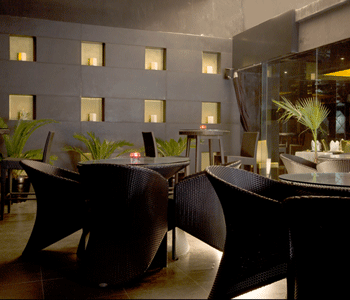
For years and years, this award has gone to the relatively obscure “The Chinese” in Connaught Place. But because the road outside the restaurant has been dug up for months making access difficult, I’m giving “The Chinese” a break this year.
Instead the award goes to the Delhi branch of Royal China, a London-based chain of separately-owned restaurants. There are already popular Royal Chinas in Bombay but they are not in the same league as the Delhi outpost with its exquisite dim sum, its great roast pork and its perfect stir-frying.
The restaurant’s only handicap is its location on the higher floors of an office building in Nehru Place but once you get inside, the food is so good and the view so wonderful that you’ll forget that you are in an office building.
Best European: Orient Express
This is one of those categories where things rarely seem to change. In terms of service, the Orient Express is Delhi’s finest restaurant. Partly because it is small, waiters and chefs ensure that every guest is made to feel special. Small wonder then that it is the first choice for a birthday, an anniversary or a celebration of any kind.
The food can be outstanding. Chef D N Sharma has been a mainstay of the kitchen for years. Along with Chef David Tilly, he ensures that the food is sophisticated and delicious. You don’t have to order the luxury ingredients – foie gras, truffles, wagyu etc. – but if you do, rest assured that this is the one restaurant in Delhi that will do justice to them. Service under Ashutosh Kapoor is flawless. This is the restaurant where Delhi’s A list feels totally at home, so you will probably see at least one famous face each evening – if not more.
There was a time when the Orient Express was considered wildly expensive. It is still not cheap. But it is not as expensive as at least four other hotel restaurants I can think of. And it has the best and most reasonably-priced wine list of any hotel restaurant in the city.
Best Indian: Dum Pukht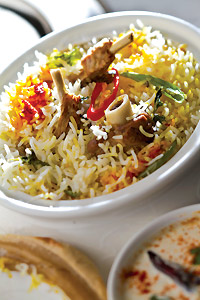
The reason I like the redone Dum Pukht is because it is one of a kind. Whenever expensive Indian restaurants are designed (and Dum Pukht re-opened last year in a new room designed by a Bangkok-based interior consultancy), they always change the menu to make it more “modern Indian”. But ITC has held firm with Dum Pukht. Even though the room has a contemporary feel to it, the food is still traditional North Indian.
And it is still terrific. These are the best kakori kababs in the world, the juiciest raans and the most amazing biryanis. Dum Pukht is justly famous for its gravy dishes but vegetarians may want to try its yellow dal, a worthy rival to the more famous black dal they serve upstairs at Bukhara.
Best Japanese: Wasabi
Ever since Sakura closed down for refurbishment, there has been no alternative to Wasabi for classy Japanese dining in the heart of the city. That said, modern Japanese has rarely been done better anywhere in India. It is a measure of Wasabi’s success that its only rival in food terms is the Bombay original.
Both Wasabis grew out of a collaboration with the Japanese Chef Masaharu Morimoto. Though the food at Morimoto’s New York restaurant can be fresh and original, the Indian Wasabis began by serving clones of the Nobu menu (Morimoto was Executive Chef at the New York Nobu), which delighted diners in Bombay and Delhi.
Now, the Wasabi menu is a little more daring. Some of Morimoto’s own classics have made the cut, Hemant Oberoi has created a whole range of vegetarian Japanese items and in Delhi, Chef Vikramjit Roy has introduced his own creativity. Add to this, superlative sushi made by Japanese chefs sent over by Morimoto and you can tell why the food is always so good.
Akshay Tripathi, the manager who opened the restaurant has been promoted but his successors have maintained his high standards.
Best Oriental: Pan Asian
One of the enduring mysteries of Delhi’s food scene is that though it is easy to get good Japanese or Chinese food in the city, there are so few superior Thai restaurants in Delhi, making it tough to find good Thai food.
Till that is set right however, we have Pan Asian at the Sheraton in Saket. Most of ITC’s many Pan Asians only work in parts (you can eat well at the Bombay Pan Asian if you restrict yourself only to Chinese), but the Delhi Pan Asian is easily the best of the lot – or at least it has been since Benita Sharma took over as the General Manager of the hotel.
Under Sharma, the Chinese food, which was the restaurant’s mainstay, has remained good (though they need a new Peking Duck oven) but the Thai has improved immeasurably to the extent that Pan Asian has the second-best Thai food in Delhi (the best is at another multi-cuisine restaurant, Setz) and, after they stole the chef from Sakura, the best traditional Japanese in all of North India. (The only competitor is Edo in Bangalore).
So, nowadays, if I want Thai or traditional Japanese I tend not to go to one of the specialty restaurants, but head directly to Pan Asian. Where else can you start with Sushi, move on to Som Tam and end with Red Curry?
Best Indian: Dum Pukht
The reason I like the redone Dum Pukht is because it is one of a kind. Whenever expensive Indian restaurants are designed (and Dum Pukht re-opened last year in a new room designed by a Bangkok-based interior consultancy), they always change the menu to make it more “modern Indian”. But ITC has held firm with Dum Pukht. Even though the room has a contemporary feel to it, the food is still traditional North Indian.
And it is still terrific. These are the best kakori kababs in the world, the juiciest raans and the most amazing biryanis. Dum Pukht is justly famous for its gravy dishes but vegetarians may want to try its yellow dal, a worthy rival to the more famous black dal they serve upstairs at Bukhara.
Best Japanese: Wasabi
Ever since Sakura closed down for refurbishment, there has been no alternative to Wasabi for classy Japanese dining in the heart of the city. That said, modern Japanese has rarely been done better anywhere in India. It is a measure of Wasabi’s success that its only rival in food terms is the Bombay original.
Both Wasabis grew out of a collaboration with the Japanese Chef Masaharu Morimoto. Though the food at Morimoto’s New York restaurant can be fresh and original, the Indian Wasabis began by serving clones of the Nobu menu (Morimoto was Executive Chef at the New York Nobu), which delighted diners in Bombay and Delhi.
Now, the Wasabi menu is a little more daring. Some of Morimoto’s own classics have made the cut, Hemant Oberoi has created a whole range of vegetarian Japanese items and in Delhi, Chef Vikramjit Roy has introduced his own creativity. Add to this, superlative sushi made by Japanese chefs sent over by Morimoto and you can tell why the food is always so good.
Akshay Tripathi, the manager who opened the restaurant has been promoted but his successors have maintained his high standards.
Best Oriental: Pan Asian
One of the enduring mysteries of Delhi’s food scene is that though it is easy to get good Japanese or Chinese food in the city, there are so few superior Thai restaurants in Delhi, making it tough to find good Thai food.
Till that is set right however, we have Pan Asian at the Sheraton in Saket. Most of ITC’s many Pan Asians only work in parts (you can eat well at the Bombay Pan Asian if you restrict yourself only to Chinese), but the Delhi Pan Asian is easily the best of the lot – or at least it has been since Benita Sharma took over as the General Manager of the hotel.
Under Sharma, the Chinese food, which was the restaurant’s mainstay, has remained good (though they need a new Peking Duck oven) but the Thai has improved immeasurably to the extent that Pan Asian has the second-best Thai food in Delhi (the best is at another multi-cuisine restaurant, Setz) and, after they stole the chef from Sakura, the best traditional Japanese in all of North India. (The only competitor is Edo in Bangalore).
So, nowadays, if I want Thai or traditional Japanese I tend not to go to one of the specialty restaurants, but head directly to Pan Asian. Where else can you start with Sushi, move on to Som Tam and end with Red Curry?
Best Brunch: ITC Maurya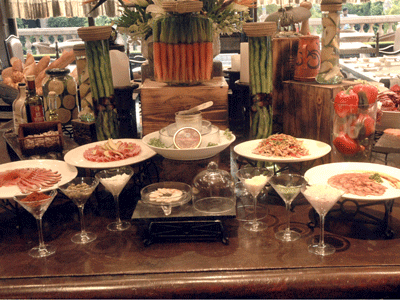 West View, at the top of the Maurya, has always been a restaurant in search of a purpose, while its neighbour My Humble House has only just turned around. But somehow, when you go to the Summit Brunch on Sundays which allows you to eat from both the West View and Humble House kitchens, it is easy to forget what the history of both restaurants is.
Masterminded by the hotel’s new kick-ass General Manager Anand Rao and its brilliant Executive Chef, Manisha Bhasin, the Summit Brunch is ITC’s attempt to show off the best it can do: superlative dim sum, live noodle counters, stir-fries made to order, grills, artisanal pasta, foie gras, caviar, oysters and all the champagne you can drink.
