WSA & HKIWSC: Tale of two International Competitions(1)


|
Two back-to-back international wine competitions were held last week in Singapore-Wine Style Asia and Hong Kong-Cathay Pacific Hong Kong International Wines and Spirits Competition (HKIWSC), both with a distinct personality, each one important not only for importers in their respective countries but also within South East Asia, writes Subhash Arora who had been invited again at both these annual events as the panel president. | ||||
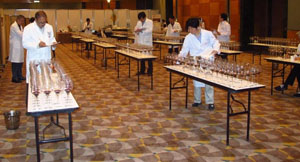
A total of 1726 entries including about 120 spirits were clocked in at the Cathay Pacific HKWSIC in Hong Kong, only in its 3rd year. The HKIWSC was held on 12-14 October at the Hong Kong Convention and Exhibition Center where the Hong Kong International Wine Fair will be held on November 3-5 this year by HKTDC. The competition saw 1500 entries last year but had reached only around 1300 until a few days before the closing date. Suddenly it shot up to cross 1700, due to visibly unexplainable reasons but ostensibly due to one-woman campaign by the unassuming and affable Chairperson Debra Meiburg MW who had made all-out efforts to woo the producers who are already primed to enter the Hong Kong market. India had a symbolic presence with 7-8 wines. Judging at HKIWSC was a hectic but enjoyable learning process for the judges who blind-tasted over 400 wines in 3 days. I tasted wines from Georgia, Portugal, Brazil, Uruguay, Hungary, US, Chile, Argentina, Turkey, Japan, India, Spain, China, Canada, Thailand, Serbia, Australia, New Zealand, Germany, Malta, Greece, Tunisia, Lebanon, Russia, Macedonia, Russia, Romania, Slovakia, Austria, England and even HK, besides France and Italy . By the end of it all, the palate was speaking languages one might not understand for a while.
HKIWSC also has 100 points scale but the wine needs to score 87 for a Bronze, 90 or more for Silver and 94 for a Gold medal. Each flight usually had 30-55 wines pre-poured in the glasses on a single table for each of the five judges in a panel, who are expected to mentally do the math after judging the colour, aromas, taste and end and note down the aggregate score they think the wine deserves and whether the wine it should be awarded a medal. An average is calculated and in case of a wide disagreement, the judge scoring outside the general consensus gets a chance to defend his score based on the individual tasting notes. One is free to express the logic behind the individual score and after discussion the consensus score is awarded to the wine. In case of a strong disagreement, Chairperson’s comments are taken place before finally awarding the score and recording the medals. ‘My logic of scoring after tasting a wine is personal but objective,’ says Debra. ‘If I think I would serve a wine to a senior colleague whom I respect, say Jancis Robinson, I would give it a Gold. If I want to offer it to the wine connoisseurs of Hong Kong I would give it Silver. If it is a wine I would love to sip while cooking, it deserves a bronze.’ In zest and in lighter vein she said that the wine she would serve to her mother-in-law is the wine that would get no medal. (with due apologies to her husband Patrick- she gets along very well with hers)
A fellow judge in several competitions including the OIV-based German MundusVini where he is a Director and where the judges are not disclosed the grape variety or the country of production and are not allowed to discuss or change their scores, Robert feels this may strangulate the initiative in a judge and may dissuade him to take a strong stand for or against an individual wine. ‘The judges are also the lawyers for a wine. After they have scored their wine to the best of their capability, they ought to discuss and adjust the scores and take the jury chairperson’s advice, if need be, before deciding on the medal. Otherwise, there is also no learning possibility for the judges who often feel frustrated. Learn baby learn Of course, the names of grapes like Saperavi, Chinuri, Mtsvane, Tsitska, Rkatsiteli, Tsolikouri– the indigenous grapes of Georgia might have been all Greek to the majority of the judges. But Roupeiro, Perrum, Rabo di Ovelha from Portugal would have been also their first encounter. Lunel, Koverszolo and Zeta may not sound sweet but made some excellent Tokaj sweet wines from Hungary. It was a first time for me to taste Muscadine from North Carolina-a non vitis vinifera and or a vitis lambrusca variety, grown in 10 American states in the eastern belt-it even has a North Carolina Muscadine Producers Association. I was impressed with the specialized knowledge of one of the Chinese judges who is a PhD Professor in Beijing. One needn’t have tasted a Vranac from Macedonia earlier to realise that it made intensely perfumed red wine. It was a discovery to realise that the GreekMoschofilero would need evolved palate to be popular in India but Assyrtico, Athiri, Liatikoand Aidani from Greek islands made an excellent sweet wine. I had no clue that Palavafrom Slovakia was capable of making quite an aromatic sweet wine. I knew Vidal makes excellent Canadian ice wine, but a wine from Optima grapes from Okanagan Valley was a special sweet surprise. It would have been a great learning experience for judges from the other three panels as well. From www.indianwineacademy.com
|