Behind the buzz about Black Ankle Vineyards(2)


“Our approach has been influenced by the growth of slow food movement and the concerns of bio-diversity,” O’Herron said, noting that sustainable methodology and bio-dynamic systems are incorporated into all aspects of their operation. Some prized Gloucester Old Spot Hogs (a key component in their upcoming “Wine and Swine” event), a few head of cattle and some chickens pecking around on the property underscore her point.
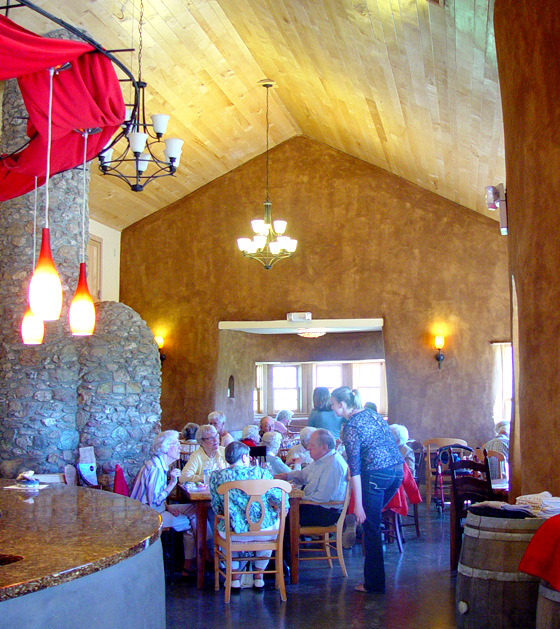
The Black Ankle tasting room. (Photo by Francine Halvorsen)
Their basic task, though, was to precisely profile Black Ankle’s growing environment – its climate and rainfall, etc. – and match the right grapes to their setting. They started selecting grapes that would grow well with no irrigation.
“The roots dig deep to find moisture and nutrients,” she said. “That process produces a rich and complex flavor.”
Getting the Juices Flowing
The first grapes were planted in 2003 and harvested in 2005. Then in 2008, the first wines were bottled and sold that fall. They’ve done two since then and will be doing another soon.
I asked O’Herron to walk me through the process.
“When we are ready for the harvest, all hands pick the grapes, and they are washed and settled into the crusher. From the crusher they go to the tank, where they rest for four to six days.
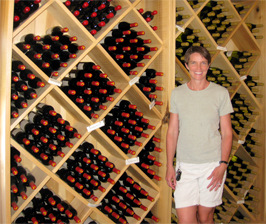
Sarah O'Herron, co-owner and vintner, Black Ankle Vineyards. (Photo by Francine Halvorsen)
“The juice starts to flow and the extraction begins. The juice is clear and flavorful, the skin adds color and additional flavor. After a while the wine is stored in French oak barrels to ferment.”
Sustainability is built into not just the wine-making but the architecture and design of the structures on site. The winery is built of regional wood, rocks and straw.
The roof is covered in sedum, a succulent used to help temperature control. The interior is “green” as well.
The tables are made locally from local wood and the bar top is composed of grapevines and grape pomace (the skin, stems, seeds, and pulp of grapes or olives) sealed in organic resin.
I asked O’Herron to talk about their Bordeaux-type blend, the 2008 Crumbling Rock, a two-time Maryland Governor’s Cup winner.
“It has a long aging process, which gives it a beautiful structure,” she said. It is 57% Cabernet Franc, 21% Cabernet Sauvignon, 12% Merlot, 8% Petit Verdot, and 1% each Malbec and Syrah. Each grape is fermented and barrel-aged individually and then blended.
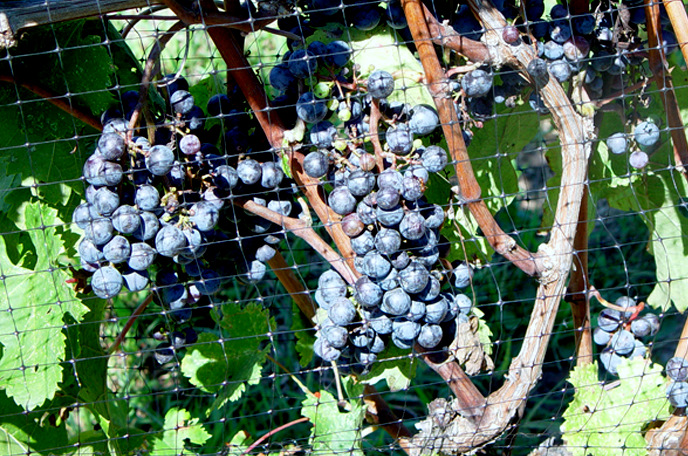
These grapes are just about ready for harvest. (Photo by Francine Halvorsen)
“We like it on its own with some bread and cheese,” she said. “With meals, it’s good with meat or mushroom dishes and will stand up to something spicy.”
Recipe for Bedlam
Their 2010 Bedlam is unusual, O’Herron said, in that it is the result of a co-fermentation process, not blended afterwards.
They press small lots of white and the result is: 36% Viogner, 23% Muscat, 17% Gruner Veltliner, 17% Albariño and 7% Chardonnay.
“We only produced 102 cases of this,” she said. “We take pleasure in using modern technology in a very old-fashioned process.”
At the end of the day, my flavorful visit to Black Ankle Vineyards finished with a note of uncertainty.
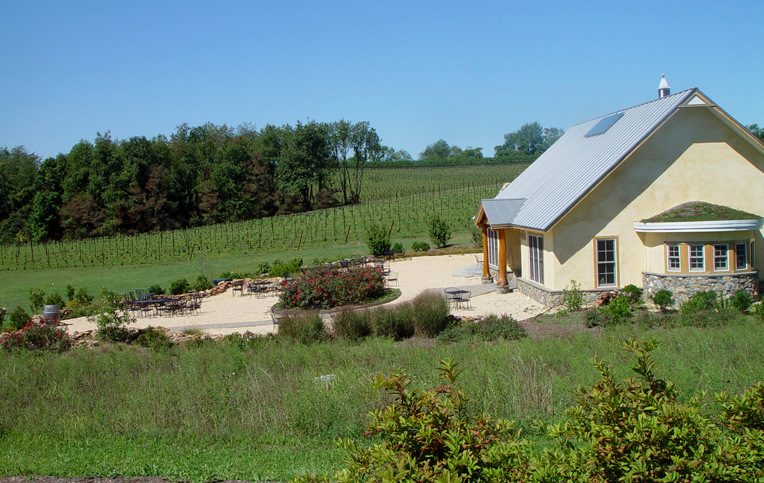
The tasting room at Black Ankle, young vines in the background. (Photo by Francine Halvorsen)
On the one hand, it is a storybook vineyard: picture-perfect, bio-diverse, transparent in its practices, and to my taste, a producer of excellent wine. And yet I had to wonder, was I just swept away by the magical setting?
How would Black Ankle stack up to similar kinds of wine – with lower and higher price-points – if I made the comparison back in less-than-magical Baltimore?
That’s what you’ll find out in Part Two of this story.
