Critic’s Notebook: Cabernet franc, the food-friendly red(1)


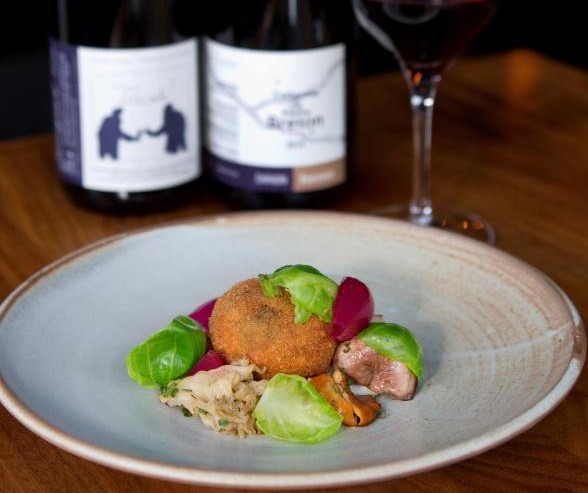
Blood sausage croquettes paired well with cabernet franc at Les 400 Coups. They were prepared by chef Marc-André Jetté.
Photograph by: Allen McInnis, THE GAZETTE
MONTREAL - There’s a great little book called The Wine Avenger (Simon & Schuster, 1998) that changed the way I think about wine. Written by an American named Willie Gluckstern, The Wine Avenger covers such key topics as wine storage, decanting, serving temperature, how to save opened wine, and how to avoid getting ripped off in restaurants. Yet between Gluckstern’s rants against merlot and his praise of Germanic grapes, the most valuable information focuses on which wines pair best with food.
Some wine writers explore the food and wine pairing as a sort of oenological art, with intricate recipes required to match a specific wine down to the correct vintage. But realistically, most wine drinkers require far wider perimeters, especially when choosing from a restaurant wine list.
According to Gluckstern, the most popular wines made with chardonnay and cabernet sauvignon are incompatible with food, primarily because many are imbued with oak, which he refers to as “the MSG of wine.” At the table, Gluckstern prefers wines that are high in acid and medium-bodied.
In white, his taste runs to sauvignon blanc (France and New Zealand only) and his all-time fave, Riesling. As for red, he champions pinot noir, Gamay and barbera. Yet cabernet franc, that under-appreciated varietal that often plays a supporting role to the more glamorous cabernet sauvignon, is his red-food-wine of choice. Topping his list are the cabernet franc wines of the Loire including Chinon, Bourgeuil and Saumur-Champigny, of which he writes: “I have come to believe that a well-made Saumur-Champigny – with its medium weight, ripe piquant fruit and delicate herbal finish – must be, dollar for dollar, the best of all possible red wines for food.”
Bold statement, granted, especially for us Montrealers who have a paltry selection of Loire reds on the majority of restaurant wine lists. The SAQ selection is nothing to write home about, either. Yet seek them out we must! I have been putting Gluckstern’s theory to test in my last decade of restaurant feasts since I read his book, and The Wine Avenger is on the money. A meal shared at Les 400 Coups with Loire winemaker Pierre Breton of Domaine Catherine et Pierre Breton, further showed how beautifully cabernet franc shines at the table.
Breton, who was in town for La Grande Dégustation de Montréal (the wine and spirits show) in late October, is one of the most respected “vignerons” in the Chinon and Bourgueil appellations. Besides his cab franc creations, he also produces a magnificent Vouvray, which was served with a stunning dish of lobster with avocado, cucumber, apples and yuzu. His wines are biodynamic and range in intensity from the young and fruity Bourgueil Trinch! (named for the sound of two glasses clinking), to the old vine-derived Nuits d’Ivresses. The pairings were brilliant.
Lobster aside, we enjoyed a blood sausage croquette with Breton’s Chinon Beaumont, 2010, and a pork belly/pork loin duo with sunchokes, chanterelles and long pepper jus with his Bourgueil, Clos Sénéchal, 2009. These are not wines that steal the spotlight so much as support the food with subtle and spicy fruit. Light-bodied, they are also oh-so quaffable.
On the topic of why cabernet franc wines pair so well with food, Breton had plenty to share at the table. “You either love or detest cabernet franc wine,” he says. “It’s an austere, cold-climate wine. I like that austerity. They’re not too tannic, nor too heavy. They are elegant and silky, and they pair very well with game, duck and marbled beef, also with charcuterie, like rillettes and pata negra (Iberian ham). And the lighter wines also work well with fish, especially grilled fish including salmon, tuna and mahi-mahi. And a richer, older wine is perfect with pork chops, rabbit or truffled Bresse chicken.”
So why is it that when I say the words “cabernet franc” to many wine snobs, they make a face? Says Breton: “It’s not a varietal we are immediately drawn to. Cabernet franc can have an off-putting vegetable flavour. A taste of tomato leaf is more typical, pleasant even. But when it’s made with unripe grapes, and from too-high volumes, it’s undrinkable. Or it can be too rustic, with heavy tannins. But if the wine is well-balanced, that will not happen. The taste should be delicate yet complex.”
Breton also believes cabernet franc wines need time to soften. “We drink them too young,” he says. “Ten years of age would be ideal. With time, the wines take on flavours of strawberry and raspberry, and ideally a taste of woodland strawberries and rose petals. Also spices – especially pepper – and truffles. It’s orgasmic. If I were a restaurateur, I would buy these wines and cellar them for 10 years. That would be perfect. And the value for money is unbeatable. I have a wine that received a high score from (wine critic Robert) Parker that sells for 12 euros.”
