Organic labeling can be food for thought(2)


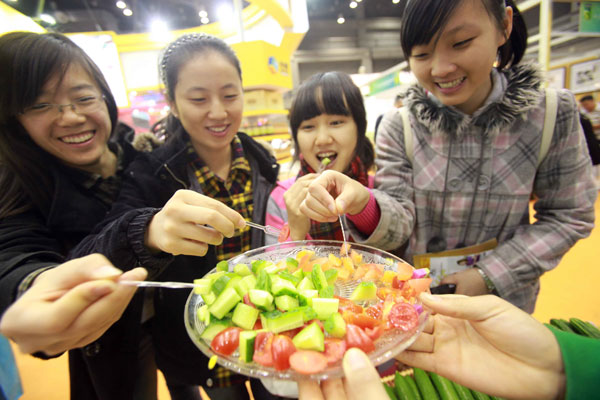
People taste tomato and cucumber at the seventh China International Expo of Organic Food, held last month at the World Trade Center in Beijing. Although many vegetables sold at markets are labeled as organic, few have been certified. [Chen Xiaogen / for China Daily]
New standards
A senior staff member from one of China's 23 official certification bodies, who spoke on condition of anonymity, disclosed that a new national standard will be unveiled in March to ease the chaos. The standard will include four important changes from the original, in 2005. This staff member has been working in organic food certification for about eight years.
He said the first two changes will concern the transition period, akin to probation, when a farm applies for the certification of land. It lasts for 24 or 36 months, depending on the crops grown there, and farms must begin following organic practices three or four months before the transition period.
Under the current standard, as soon as farms enter the transition, they can obtain yellow certification, indicating their products are moving toward organic. Green certification is granted only if the farm passes probation.
"The problem with this stage is that, under the current standard, a farm can get a transition period certificate, even if it only stopped applying chemicals on the crops three or four months earlier," the senior staff member said.
Under revised procedures, no certificates will be issued in the first 12 months of transition. "That is to say, the farm will have to stop using chemicals for at least 15 months before it can receive a yellow certificate," he said.
Also, farmers will not be allowed to label their products "organic transition food", which has been used to denote food that was better than ordinary but not as good as organic. The staff member also said the new regulations will set the acceptable level of pesticide residue at zero. The current standard allows "one-20th of that found in ordinary food".
In addition, serial numbers will be introduced for each product. Consumers will be able to check with the body that authorized the product on the website of China's Certification and Accreditation Administration.
'The price of faking'
The staff member said the administration of organic food has been getting tighter since a number of problems arose in 2003. Typical problems then, he said, were the sale of different certificates in bundles and charging fees for one certificate several years in advance, even though there's no guarantee the farm could pass the test in those years.
Issuing certificates is the only method for the bodies to gain income, he said, so there are incentives to issue them outside the rules. "I can't say that the new standard will solve all the problems with the certification of organic food right now," he said, "but the price of faking will be much higher."
He acknowledged that many customers are ignoring national certificates and relying on personal relationships with small farms so they can distinguish real organic food from fake.
"Unauthorized small farms are actually a good thing in this industry," he said. "Their products may not be 100 percent organic, but at least they are free of chemicals and pesticides."
Ways out
Food safety issues have driven many large State-owned enterprises into the organic food industry. Xia Hongzhi, general manager of Beijing Fuhaihuakang Organic Food, said China Minsheng Banking and China Petroleum & Chemical are among his clients.
"They rent a piece of land from our farm, and we are responsible for the growing and quality control," Xia said. "They can send their people to monitor us during the entire process."
Sun, the small farmer in Shunyi, said he thinks that both government and customers pay too much attention to the industry. "Organic is high-end, even in Western countries," he said. "Counting on it to solve the food issues of hundreds of millions of people is unrealistic."
Sun's claims were supported by the senior certification staffer. "Unlike domestic (Chinese) consumers, Western buyers don't go after organic food for safety, because most of the food they can get is safe anyway. They are buying it with the intention of contributing to environmental protection, which is also the original intention of the term."
He said organic food is simply the bottom line at the technical level. The core ideas - sustainable land use and reduced use of outside energy - are the important factors.
Sun thinks there is no reason to be afraid of chemical fertilizers and pesticides, as long as they are used within prescribed limits. Leaving land fallow on a regular basis, allowing it to recover from use, is also crucial.
"If ordinary vegetables, which occupy most of the market share, could be guaranteed as safe - not necessarily organic, but safe - without the excessive use of pesticides, for example, that would prove a real resolution of the food safety issue," he said.
