National holiday can make a world of difference to business(1)


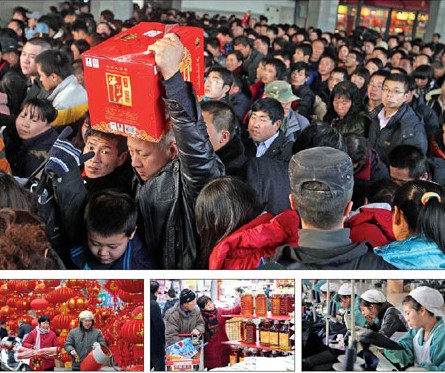
Clockwise from top: Passengers at the Beijing Railway Station head home for the lunar new year. Most Chinese factories will close for the holiday week after a burst of productivity. These women at a garment factory in Huaibei, Anhui province, make goods for export to the United States. Plans for family reunion meals prompt people like this couple in Binzhou, Shandong, to stock up on supplies. Decorations, like these in Fuyang, Anhui, set the atmosphere for lunar new year. Wang Jing / China Daily Lu Qijian / for China Daily Provided to China Daily
Spring Festival has ramifications for global trade, Andrea Fenn reports from Shanghai.
With Lunar New Year just days away, most Chinese people are savoring a week of holidays, family reunions and feasting, charging up for the Year of the Dragon.
But when China's most important festive period shuts down the country's production system for a week, trade flows are disrupted and private consumption grows. The results are an inconvenience - or an opportunity - for different industries around the world.
China traditionally experiences a boost in production before Chinese New Year, led by greater demand for goods and services. The country's purchasing managers' index, which shows companies' purchase of goods and services, rose 1.3 points in December to 50.3.
That greater manufacturing activity dives once the holidays begin and some 250 million factory workers return to their hometowns. China's GDP in the first quarter last year was 14.3 percent less than the second, mostly due to the seasonal business closures.
According to Andrew Tilton, senior economist at investment banking firm Goldman Sachs, China's holidays have enormous impact on global trade flows because the country is the world's biggest exporter and on track to become the largest importer by 2014.
Tilton said that economists try to balance calculations assuming average timing, but Chinese New Year is a moving holiday. Out-of-average occurrences can produce stark effects on figures.
"Last year turned out to not show as big an impact, but with the Chinese New Year much earlier this year, there are likely to be more visible effects," Tilton said.
Materials and travel
Asia is where the effects are felt most strongly. China is by far the continent's biggest importer, and entire raw material sectors in the region depend on its industrial demands. For this reason, countries that do not officially celebrate the lunar new year, such as Australia and the Philippines, adjust their economic indicators to budget its impact.
Last year, Chinese imports from the Philippines fluctuated by 48.9 percent around the new year, showing strong correlation between the holiday and bilateral trade flows.
