Digging up China's bones(1)


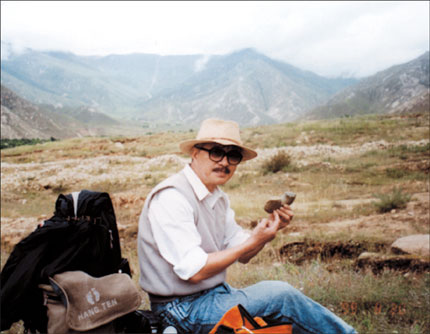
Zhou Guoxing works at an excavation in the Tibet Autonomous Region.
ZHOU Guoxing has tracked missing skulls of Peking Man, led expeditions in search of the Chinese Wild Man and the Abominable Snowman, made major discoveries about human origins and helped police with forensics.
Paleoanthropologist Zhou, 74, a former director of the Beijing Museum of Natural History, received a Lifetime Achievement Award from the Shanghai Anthropological Association last November at Fudan University; he delivered a talk and spoke to Shanghai Daily. "Anthropologists are explorers who adventure into the past," he said.
Zhou has been at the forefront of some of the most significant excavations in China and played a leading role in the study of human evolution. He maintains there are multiple origins of Chinese culture, noting that besides the Yellow River, the Yangtze River is another cradle of ancient civilization. By studying the Yuanmou Man's fossils and artifacts in Yunnan Province, he confirmed that Chinese history started at least 1.7 million years ago. His findings were detailed in the article "On the Start of China as History" (1998).
He led the excavations of the Mesolithic Bailiandong cave sites in the Guangxi Zhuang Autonomous Region and accidentally came upon evidence of the Lingjing Mesolithic culture in today's Henan Province. He got a clue when he spotted deposits of quartz, a mineral commonly used to make tools. At the time he had been sent to the countryside in a campaign called the "four cleanups" in 1964. Official excavation began in 2005.
Unlike many other scientists who confine their work to the field or laboratory, Zhou spreads the word through popular science books and is dedicated to promoting science by writing. In 1990 he was named Distinguished Popular Science Writer by the Chinese Association of Popular Science Writers. Today he is writing about his adventures in search of the Chinese Wildman of Hubei Province. Although he has debunked the stories, he thinks mysteries spur curiosity and encourage young people to be interested in anthropology, archeology and other fields.
"I'm very willing to write, but lots of scientists are not interested in publishing popular science. Chinese academic emphasizes on quantity of papers published as a prime gauge of advancement.
"Scientists have the responsibility to introduce research findings to the public at the appropriate time, instead of holding them as their private hobbies," Zhou said.
Zhou, wearing a mustache and dark-framed spectacles, has fascinating stories to tell and he's eager to tell them.
Early life
Born in 1937 in Nantong City, Jiangsu Province, Zhou attended schools in Nantong before attending Fudan University, where he majored in anthropology; in 1962 he went on to the Chinese Academy of Sciences. In 1979 He joined the Beijing Museum of Natural History, first as head of anthropology, later as head of the museum.
His interest in anthropology started in high school.
"I have always loved nature since I was a child, and became fascinated by Darwin's theory of evolution in high school," he said. Zhou read widely and determined to study people born hundreds of thousands of years ago.
One afternoon while he was in high school, Zhou came upon a cemetery and saw an open coffin. He stooped down to have a close look.
"I found a round object, a human skull," he said. "It was very smooth and hideous, but I wasn't frightened of it at all."
He wrapped it up carefully and took it back to his dorm where he cleaned it meticulously, then placed it beside his bed and treated it as a treasure.
"I feel for them. Those dry skeletons used to be flesh and blood. They are sad."
He clearly remembered how he acquired skeletons for the anthropology department's researchers when the city cleaned up unidentified tombs in the Dachang Cemetery in 1960.
"I opened up a tomb and was surprised to find a young girl's skeleton. He found her pen and diary, which told him she was a 16-year-old soldier in the People's Liberation Army.
Human skulls and other remains have a kind of life in Zhou's view and he "reads" them to understand how early humans lived.
"People have misunderstandings about the dead," Zhou said. "The really dreadful ones are the living persons. You hold the skull in your hand, and it won't bite you, rob you or attack you," he said.
