Liqueurs: Born again brands(1)


Liqueurs are enjoying growth, in both established and emerging markets, and some traditional brands are attempting to reinvent themselves for the younger generation.

Perhaps the most telling aspect of a new advertising campaign by Drambuie came when senior brand manager Vicki Wonders announced the intention was to encourage younger drinkers “to reconsider the brand and its place in their repertoire”.
Despite figures which show the liqueur category is enjoying one of its best spells of recent times, there remains an underlying truth that traditional liqueurs are not viewed as “hip” among the younger generation of drinkers.
Drambuie has, to its credit, recognised this and, although it steered clear of admitting so, the fact that its latest campaign was dubbed a “major departure” by its own marketers illustrates clearly that they realised something needs to change.
What they have set out to do, in the words of the creative folk behind the campaign, is to “build a sense of intrigue” around the brand and tempt consumers to try it because, quite simply, the vast majority of the 25-44-year-old professional “creative class consumers” have not ever done so.
Yet Drambuie is not alone in this predicament. Bénédictine used London Cocktail Week a couple of months ago to try to reach out to a new set of consumers, many of whom would have been forgiven for knowing nothing about the drink. After all, when was the last time you saw the French liqueur on offer at your local or at the supermarket? And in this market, those who are shy face fading into the background.
There have been signs of a mini-revival for Drambuie over the past year, with total global volume sales rising by 1% with particularly strong growth in exports to Latin America.
However, volumes were hit hard by the ongoing economic problems in Greece – its third-biggest export market – where consumption was down by a third and shipments down by more than 50%.
The brand did, however, turn around several years of decline in US sales, while there was also a 4% increase in shipments to the US. Sales in Northern and Eastern Europe rose by 13% and in Latin America by 18%. All of which suggests that there is a renewed appetite for such a style of after-dinner drink in certain areas.
Western Europe, as figures from Euromonitor illustrate (see table), is by far the largest market in the world for liqueurs of all
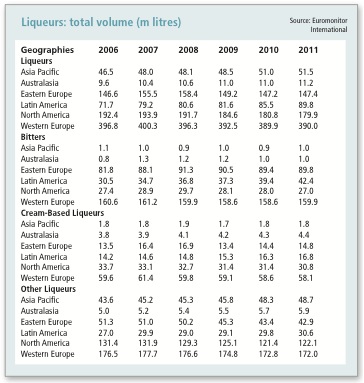
styles, followed by North America, though the category suffered decline in the US and Canada due to a drop in the sales of bitters (Jagermeister is not included in these figures as Euromonitor classifies the brand as a “spirit”).
Australasia and Asia Pacific remain challenging areas for the liqueur category, but at least they have, for the most part, shown growth over the past year.
Indeed, Sophie Godefroy, marketing and communications manager at Giffard, is of the belief that Asia can be viewed as a real opportunity for liqueurs.
“Liqueurs do well in areas that have a thriving cocktail scene, and the scene in Asia is certainly on the up,” she says. “Countries like China, Hong Kong and Singapore represent a massive opportunity.”
Mix it up
Brands such as Kahlúa, Bols, Disaronno, Mozart and Grand Marnier can be found on cocktail menus across the globe, and bartenders seem to enjoy countering their overt sweetness with the bitterness of citrus or the bit of herbs and spices in order to create an endless list of variations on a theme. This is where the opportunity for supposed “past-it” brands such as Drambuie and Bénédictine is most apparent.
Recently we have seen the emergence onto the cocktail scene of brands which were seemingly consigned to after-dinner drinking history. So now mixologists are experimenting with the likes of Drambuie and Bénédictine, and the brands themselves are investigating ways to claw their way back to the forefront of the market, as illustrated by Drambuie’s latest campaign.
Another brand looking to arrest recent decline is Malibu, which has just completed a two-year, £14 million UK marketing campaign under the banner “Get Your island On”, aimed at 18-24 year-olds.
The campaign aimed to position Malibu as a versatile, sociable drink and encouraged consumers to tap into the brand’s Caribbean ethos.
The UK is the second largest market in the world for Malibu sales, with 4.4m bottles sold in the country every year, accounting for 12% of the brand’s total global volumes.
Despite the relatively stable nature of Malibu’s performance, Malibu owner Pernod Ricard still felt it necessary to continue to reinvent and reinforce its message across its target market, due to the resurgence of its competitors and the emergence of new sub-sectors within the liqueur category.
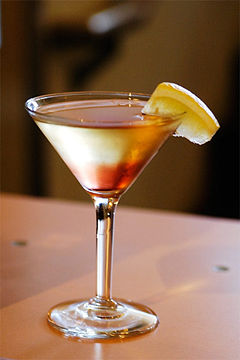
This includes the advent of the clear cream liqueur category, heralded by the release of Triibe in 2008. The drink is aimed at the younger generation of drinkers and has one distinct advantage over its cream liqueur rivals – mixability. As David Bromige, creative director at The Reformed Spirits Company, explains: “The problem with traditional cream liqueurs is their lack of mixability. I’m not talking about taste – they all mainly taste great – but the colour and tendency to curdle. They don’t make for visually appealing cocktails.”
The emergence of a host of new “trendier” liqueurs onto the market, such as Proof Drinks’ Bad Angel – a strawberry frappé liqueur that is packaged with an electric whisk to froth up the drink – has only served to exacerbate the problems faced by older brands.
The added element of theatre given by the whisking, which one would usually expect in a bar but would until recently have been deemed unusual at home, helps enhance the drinking experience and adds great growth potential.
James McDermott, director of Proof Drinks, says: “The changing drinking environment has influenced category volume rather than brand energy accounting for sales.
“More parties held at home and more pre-night-out drinks at home mean an uptake on trendy bar brands as part of ‘creating the bar at home’.
“In the bars and clubs the shot and shooters are seen as incremental volume as drinkers are continuing to buy their core drinks so it is in the interest of the trade to promote this style of drinking. The brands in the right place at the right time are riding the wave.”
