Beijing brews up craft beers(2)


Mr. Setzer initially brewed beer on Sundays and opened the brewpub for only three days a week, Thursday through Saturday. His wife helped out while he continued to work full-time as a manager in a consulting firm. Last January, Mr. Setzer left his job to dedicate himself wholly to his beer business.
U.S. microbrew beer exports to China hit a record in 2010, with sales reaching $546,000, five times the level just five years ago, according to figures from the U.S. Agricultural Trade Office in Beijing. And beer consumption overall is rising, too: SABMiller reported that China saw volume growth in beer consumption of 6% from 2005 to 2010, higher than the world average growth rate of 3.3% or the emerging-market average of 5.7%. In 2010, Chinese drinkers consumed 31 liters per capita, or 40.89 billion liters, according to Credit Suisse.
Great Leap and Slow Boat take differing approaches when it comes to ingredients. Slow Boat uses nearly all imports, including malt, hops and yeast, because it’s “comforting for local Chinese to know the ingredients aren’t Chinese, because of all the food scandals,” Mr. Jurinka said.
By contrast, Great Leap uses local hops and highlights a range of Chinese ingredients, from Sichuan peppercorns and Yunnan coffee beans to organic honey from Shandong province and a variety of teas. ”You don’t have to import quality,” Mr. Setzer said. “You can have good-quality things that are made in China, using existing ingredients.”
That appeals to the local market, he said, because “those people become strong advocates for what we’re doing. It proves you can do well-done, craft, artisan brewing in China without having to make it look American or European.”
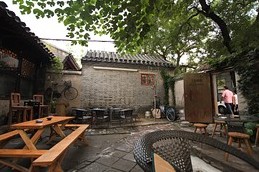
Great Leap Brewing
The courtyard of Great Leap Brewing, a brewpub in Beijing’s Gulou district.
Great Leap, which currently produces about 300 kegs a month, usually has a dozen or so beers in stock, ranging from pumpkin and cinnamon-rock ales to oatmeal and mocha stouts, as well as standards like pale and blond ales for 25 to 55 yuan ($4 to $8.70) a serve. Domestic beers like Tsingtao and Yanjing typically retail for about 15 to 30 yuan ($2.38 to $4.76) at bars and restaurants, and closer to 6 yuan ($0.95) in supermarkets.
With the ripe market, Mr. Setzer has his sights set on expansion and expects to move into semi-nationwide distribution of kegs and bottles by the fall, for which the brewery conducted a trial run from September to November last year.
Great Leap’s hutong bar is currently closed for the winter as it focuses on setting up a new distribution facility, but the brewery is still holding pop-up events around Beijing and also has kegs available for order.
Mr. Setzer says he wants the brewery to maintain an artisan product, but doesn’t think the company can avoid going big when “there’s no such thing as a mid-sized company as far as size and scope in China.”
Foreigners are among the breweries’ most loyal customers, but both said they’ve been heartened by interest from locals.
“We didn’t think that would be the case right off,” said Mr. Jurinka, but in Beijing, “the disposable income and wealth levels have reached a level where these things are now accessible.”
With relatively low per-capita rates of beer drinking, China has plenty of room for growth, Mr. Jurinka said. Besides, he added, “Why would you ever order a Tsingtao when you can order a craft beer?”
