China brings supermarket concept to North Korea(2)


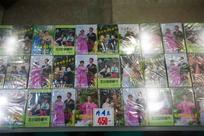
In this Sunday, Oct. 9, 2011 photo, North Korean music cassette tapes are displayed for sale at Pyongyang Department Store No. 1 in downtown Pyongyang, North Korea. A new culture of commerce is springing up, with China as its inspiration and source. The new consumerism is part of a campaign launched three years ago to build up the economy, and so the image of new leader Kim Jong Un. (AP Photo/David Guttenfelder)
In Pyongyang, middle-class shoppers buy items the old-fashioned Soviet way in dim, narrow shops: Customers line up to make their requests to a saleswoman behind a long counter, who then retrieves the items from a small selection on shelves behind her. No browsing, and not much choice even if you could.
Only the rich can afford to shop at the newfangled supermarkets, where customers choose from an array of goods and then take them to a cashier. At the Pothongmun Street meat and fish shop in central Pyongyang, the city's premier butcher and fishmonger, trained cashiers scan and tally up the items. Some even accept the two debit cards available in North Korea to foreigners and locals flush with euros, U.S. dollars or Chinese renminbi.
This Western style of shopping is still novel in North Korea, and two would-be shoppers looked perplexed by refrigerated display cases piled high with pyramids of canned whale meat and chubby rolls of kielbasa, and freezers on the floor stocked with quail meat, goose, chicken and even vacuum-packed pig snouts.
"Pick the items yourself and put them in the basket," a saleswoman in red gently advised them.
___
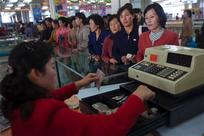
In this Sunday Oct. 9, 2011 photo, North Korean customers line up to pay for their purchases at Pyongyang Department Store No. 1 in downtown Pyongyang, North Korea. A new culture of commerce is springing up, with China as its inspiration and source. The new consumerism is part of a campaign launched three years ago to build up the economy, and so the image of new leader Kim Jong Un. (AP Photo/David Guttenfelder) PART OF A 34 PICTURE SERIES BY DAVID GUTTENFELDER
The consumer drive mirrors one 50 years ago, when Kim Il Sung was rebuilding North Korea from the ruins of the Korean War. The communist bloc was still intact, and the people were focused on building their fledgling nation. By the 1970s, North Korea had the stronger economy of the two Koreas, before the famine and tension of the 1990s.
North Korea's new economic campaign seeks to draw on the people's memories of that time and their reverence for Kim Il Sung, as well as to create a foundation for the leadership of Kim Jong Un.
For three years, Kim Jong Il laid the groundwork for his son's ascension by ushering in a new, two-pronged focus on the economy along with defense, and made it clear that there was nothing wrong with reaching out to old allies like China. Kim made four extensive trips to China in the last two years of his life, and shopping was high on his sightseeing list.
In May 2010, he visited a supermarket in the Chinese city of Yangzhou run by Suguo Supermarket Co. "Well done!" store officials quoted him as saying in comments posted to the website of China Resource Vanguard Co., the Hong Kong-based company that owns the supermarket chain.
North Korea's welcome to Chinese commerce is felt not just in Pyongyang but also in the border towns. In Rason, in the far northeastern corner where North Korea, China and Russia meet, trucks haul in goods from China, thanks to a road paved with help from the Chinese. At an indoor market visited by The Associated Press last August, women stood behind tables piled high with shampoo, binoculars and high heels. One woman was selling rabbit meat, another live chickens.
Some analysts see the boom in Chinese trade as a political move motivated by Beijing's desire to ensure stability in neighboring North Korea and to buy clout in Pyongyang. However, other say it's pure economic strategy by Chinese companies expanding their reach across Asia.
For the North Koreans, the Chinese model offers a safe and sanctioned way to explore commerce within the confines of socialism.
"China is the conduit through which the North Korean economy is becoming more internationalized," said Andray Abrahamian, executive director of the Choson Exchange, a Singapore-based nonprofit group that since 2009 has conducted workshops on business and economic policy for North Koreans.
There's a newfound thirst among North Koreans to learn about business management and financial policy, and a noticeable openness to all things foreign, said Abrahamian, who has traveled to North Korea several times over the past two years. He said younger North Koreans see business as a way to get ahead — a distinct change from a few years ago, and not just in Pyongyang.
"People in Rason say the attitude in that region toward foreigners has improved remarkably in the last few years as people get comfortable with the idea of trading with foreigners," he said.
Still, the traditional wariness kicks in. During his visit to a market in Rason, officials warned him not to take photos.
____
Back in Pyongyang, the Kwangbok supermarket is bustling. Shoppers navigate carts up and down aisles packed with 20 types of toothbrushes, a dozen varieties of beers, red carry-on suitcases and rows of black bicycles. In the produce aisle, most of the fruit and vegetables are already sold out.
Salesgirls in fire-engine red jackets deftly ring up shoppers' items and count out their change. One lane is reserved for foreigners, who are allowed to change their money into North Korean won to pay for their goods.
Kim Myong Sim, 32, said she couldn't help but think of late leader Kim Jong Il while shopping at Kwangbok, the place where he last appeared in public. Like most North Koreans, she weaves an obligatory comment about the leader into what she says, even as she chastises her nephew squirming next to the cart.
"You're getting a lot of love and buying a lot of tasty goodies, Yong Gu,'" she admonished, trying to wrest a cell phone from his mittened hands. "You've got to say 'thank you' to your aunt before you run off. You've got to give thanks to the fatherly general (Kim Jong Il) as well."
Outside the store, ornate red and gold plaques commemorate the Dec. 15 visit of Kim Jong Il and his son Kim Jong Un. High above the plaques, the Korean name of the store is written in red.
Beneath it, the Chinese name is written in green.
___
Associated Press reporter Pak Won Il in Pyongyang, and researchers Yu Bing in Beijing and Harald Olsen in Seoul, South Korea, contributed to this report. Follow Jean H. Lee on Twitter at twitter.com/newsjean and photographer David Guttenfelder at twitter.com/dguttenfelder.
