Dalian Delights: Seafood and the Wine Scene off China’s North-East Coast(1)


It’s now almost two years since my wife, Fongyee, and I moved to China to begin work as wine consultants, a profession that barely exists in a country that only really began importing wine some fifteen years ago and whose own wine industry is dominated by massive government corporations.
Much of that time has, of course, been devoted to setting up a company – no easy thing in the PRC – getting to know the wine importers and fledgling wine magazines as well as becoming more and more familiar with the different national wine markets – Beijing, Shanghai, Shenzhen and further a field – the extent of wine knowledge at consumer and trade levels, people’s expectations of wine in general and what myths v. facts abide in an emergent wine culture.
Trying myriad Chinese wines, judging at Chinese wine competitions and the teething pains of setting up a website and blog – ever works in progress – have had their own challenges. But we can hardly complain: this invaluable experience, by turns exciting, frustrating and occasionally downright baffling, has whetted our appetites and got our palates salivating. We’ll definitely be here for the long-haul, if we can.
But just as I was planning a series of posts entitled, ‘Confessions of a Chinese Wine Consultant’, going right back to January 2007 when we first landed in Beijing, I had the opportunity to go to Dalian, a popular tourist city about an hour’s flight to the north-east of China’s capital, on the attractive peninsula of Liaoning Province (which borders Hebei and Jilin Provinces, Inner Mongolia and North Korea).
As well as having a quick holiday peep at the wine scene there, Fongyee and I, at the behest of her Chinese relatives, were subjected to a two-day eating spree – Chinese entertaining is beyond bountiful – gaining some insights into how a typical middle class family sees eating and drinking and how the older and younger generations view Chinese and international wines.
Dalian is a good place to be fed to death. Our local Beijing market boasts fresh seafood from Dalian – fresh because, as in all proper Chinese markets and restaurants, everything is still alive before purchase. So we were keen to see how local Dalian folk treat their seafood and other fish on their own turf.
Fresh off our morning plane, lunch was served (the Chinese generally rise early, eat lunch around 11.30-1 p.m. and consume dinner between 5.30-8 p.m., something Mediterranean visitors find intolerable). Fongyee’s cousin had already been to the main Dalian fish market at 5 a.m. that morning and was, I’m not kidding, plating up the following feast, ingeniously prepared from one of the smallest kitchens I have ever seen (even by domestic Chinese standards). The French talk about mise-en-place, the Chinese invented it:
steamed crabs (two types – see below)
steamed abalone
steamed scallops
steamed razor clams
poached flat-fish: of Chinese origin (similar to a meaty version of sole or plaice)
stir-fried prawns with green onion and garlic
stir-fried squid with carrot, green onion, garlic and chilli
deep-fried oysters (in a very delicate batter dipped in white pepper and salt at table)
deep-fried fish in a chilli glaze: the fish was of Chinese origin (similar to perch)
braised red-cooked pork spare ribs (simmered in rice wine, dark and light soy sauce, ginger, star anise, green onion)
preserved pork gelatine salad (flavoured with star-anise and garlic)
salad of preserved pork with julienned cucumber, carrot and green onion in a garlic-soy sauce dressing
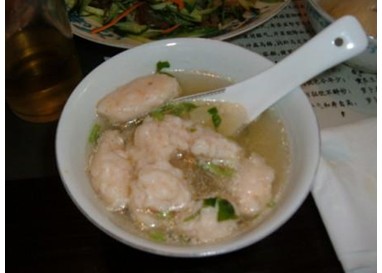
prawn soup in a delicate broth (de-shelled prawns, shaped into ovals a bit like French quenelles, with Chinese chives in a clear soup – i.e. not fish stock)
fried buns with pork and onion filling (known as xia bing).
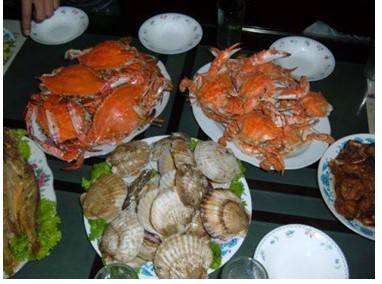
The two types of crab were ‘flower crab’ (hua xie), seen on the right above, with flower-like patterns on their shells, and ‘flying crab’ (fei xie), the bigger beasts to the above left whose shells look something like sting-rays.
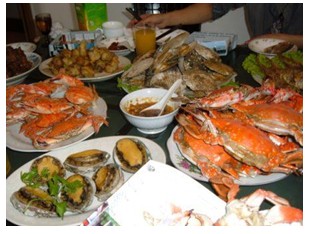
Each crab was eaten with a special dipping sauce – see middle above – comprised of minced garlic, soy sauce and ginger. But there was plentiful pickled garlic on hand just in case anyone felt their daily intake of the herb was lacking. Fortunately, we eat everything and just about anything. And who could have trouble tucking into this?
But what did this family drink? On offer was the internationally exported Tsingtao beer from another famed coastal city, Qingdao. The spelling ‘Tsingtao’ is from the Wades-Giles system of representing the sounds of Chinese characters (now defunct); but some Chinese brands/institutions like to state their age by using the early 20th Century romanized spelling replaced by pinyin after 1949 and the foundation of the PRC (the pinyin is ‘Qingdao’, pronounced ‘ching-dow’ for English speakers). There was also Chinese peach juice and the inescapable bai jiu, literally ‘white alcohol’, a category of spirits distilled from sorgum or millet which can range in flavour from delicate aniseed to rotting garbage (I don’t know how they quite manage that or what kind of ‘still’ bai jiu is actually distilled in).
We’d brought a bag of gifts with us – never go to a Chinese family without bringing something – which included a bottle of 2007 Lo Tengo Torrontes from Norton (from importer ASC). Torrontes is an Argentinian, highly aromatic grape (a bit like a cross between Muscat and Gewurztraminer with an oily and slightly bitter aftertaste) which, in our experience, has appealed to Chinese wine drinkers. But the Chinese never open gifts in front of people and it would have been rude to suggest chilling it. So we got talking about wine instead, over beer, peach juice and bai jiu.
Bai jiu is fairly evil in more than one respect. Although the northern Chinese like to drink it with seafood and just about anything, its very name has clouded the existence of white wine. Red wine is popularly known as hong jiu (literally ‘red alcohol’), but its correct, full name is hong putao jiu (‘red grape alcohol’). Because the Chinese know bai jiu as ‘white alcohol’ and red wine as hong jiu, many are unaware that white wine, whose correct name is bai putao jiu (‘white grape alcohol’), even exists. And, as we discovered in trying to find a wine shop in downtown Dalian, not everyone even knows that the lauded hong jiu – the short-hand for red wine – is made from grapes. Asking for a local shop selling putao jiu (wine in general), one security guard assured us there was nothing like that in the area, but there was a shop selling hong jiu! When Fongyee qualified ‘hong putao jiu’ the guard looked even more perplexed. But there’s nothing in the phrase hong jiu that mentions grapes, of course.
Over the prawn soup (see below), we talked about wine. Many Chinese, although they buy Chinese wines for patriotic reasons, are suspicious of the bigger brands: Great Wall, Changyu, Dynasty etc.
Their suspicions were not allayed when we revealed the big brands blend Chinese wine with imported must (whenever another country, say Spain or Chile, has a surplus); but they were interested in Grace Vineyard and Dragon Seal as producers using exclusively Chinese grapes. The older generation like their beer and bai jiu and find wine’s acidity and the tannins in red wine to be a bit unpleasant; although many older Chinese feel they should be drinking red wine for health reasons. The younger generation – in this case Fongyee’s 34 year-old cousin who works in construction and her husband, a tennis instructor – does drink wine, but there is not much of a wine-bar scene in Dalian, outside the five-star hotels.
We knew already about Dalian-based French importer DCT Wines, run by Frederic Choux. In addition, we found an intriguing wine-bar and shop called AP Wines in a local shopping mall (see below).
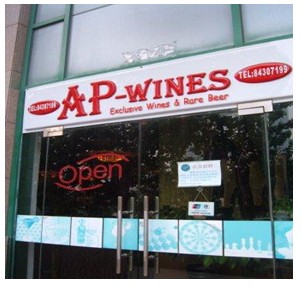
The Dalian owner spoke English and explained the wines he was importing directly. It took a while to realize that the name AP came from Australian producer, Andrew Peace, whose wines dominated the shop’s selection. All in all these looked pretty pricey by Beijing standards (e.g. well over 300RMB for a generic Coonawarra Cabernet Sauvignon) and the place had only been open a year, so perhaps business was tough. The owner didn’t let on, but was on the ball, offering a glass of 2006 Master Peace Shiraz, Andrew Peace which he apologized was a bit cold to drink as it had been stored in the fridge (at least they were trying to preserve opened bottles somehow).
AP Wines did have a few wines from France and Germany besides the Andrew Peace range. But we thought we’d shake things up a bit with our Chinese relatives by purchasing a tetra-pak, one-litre bottle of non-vintage Andrew Peace Chardonnay for next day’s feast (see below).
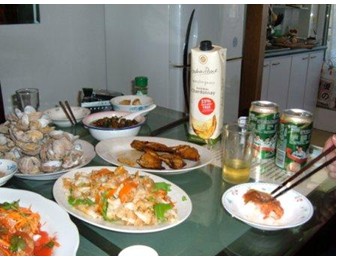
I say shake things because in a young wine market like China’s traditional packaging, cork closures and red wines generally reign supreme, even although most Chinese palates prefer lighter reds with generally low tannins (e.g. from wines made from grapes like Gamay or Pinot Noir) or whites with some residual sugar. So we’d deliberately chosen a wine under cork as a gift, albeit the plastic cork of the above Lo Tengo Torrontes before arriving in Dalian. Now, here we were a) bringing white wine to the table, b) choosing a wine in a one-litre format not standard 75 cl bottle and c) purchasing something in less than ‘classy’ packaging. We could ‘keep face’ doing this only because of our professional work and knowledge of international wines. As a result everyone in the family tried the Aussie Chardonnay and ostensibly liked it. But it was Fongyee’s younger cousins who actually drank most of the tetra-pak, saying how well the wine went with the beautiful Dalian clams on offer.
So let’s explode a few myths and report on what we learned or confirmed: it is not correct to say the Chinese struggle to drink alcohol, even wine, or are blind to trying new things (we hear a lot of importers here who insist the Chinese will only try certain types of wine – ignore them. It’s more a matter of education all round). The only Chinese who don’t drink much tend to be Cantonese. They lack alcohol dehydrogenase, the enzyme that processes alcohol – hence the pink-in-the-face routine after half a glass. These ‘wine drinkers’ should try Moscato d’Asti or another low-alcohol wine with decent residual sugar and pleasant, easy-to-like aromas. Northern Chinese drink like the Russians and Koreans: don’t take them on, particularly with bai jiu. The older generation are unlikely to be great wine buyers, unless they are highly affluent. It’s China younger drinkers who are coming to Western brands in all forms. Where wine may have the edge, though, is that it is perceived to be healthier than spirits. White wine may not be well-known, but younger drinkers will try just about anything and choosing and drinking international wines has social cachet.
The Dalian wine-lists we saw – in our hotel and a few restaurants – were dominated by the more significant importers here, particularly ASC and Torres China. But the wine scene is very young. However, there’s certainly a fair bit of cash knocking around this popular Chinese city with massive building developments and the predictable run of black S-Class Mercedes ducking between scooters and vehicles of all other descriptions.
