Chinese opera of The Immortal of Poetry-Li Bai staged in U.S(1)


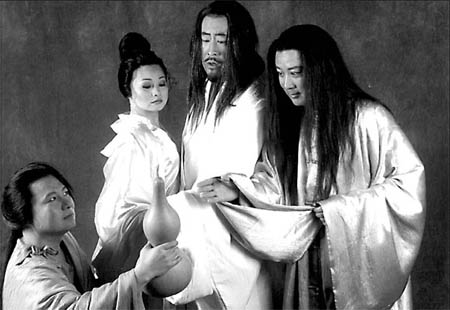
From left) Wine (tenor Chi Liming), Moon (soprano Huang Ying), Li Bai (bass Tian Haojiang) and Poem (Peking Opera actor Jiang Qihu) reveal ancient Chinese poet Li Bai's spiritual world. File photo
The night before the world premiere of Poet Li Bai at Colorado's Central City Opera, producer Martha Liao told her opera-singing husband Tian Haojiang: "I have been thinking more of the composer Guo Wenjing than you these past two years." Liao, president and co-founder of Asian Performing Arts, which co-comissioned the landmark opera, was only joking to her beloved who sings the title role, maybe to relieve some of the tension, which was rising from this time-consuming and sometimes nail-biting realization of this ambitious cross-culture project.
In 2000, Hong Kong-born Diana Liao, Martha's younger sister, a former United Nations interpreter and frequent collaborator with Chinese dramatists, set about writing a libretto about the life of Tang Dynasty poet Li Bai (AD 701-763) in conjunction with playwright Xu Ying.
Two years later, Diana Liao presented the first draft to Tian, her brother-in-law, as a birthday gift. Martha and Tian soon went to the US-based composers Tan Dun and Chen Yi but both were busy with other commissions.
In early 2005, impressed by composer Guo Wenjing's chamber opera Night Banquet staged at the Lincoln Center, Tian turned to him and Guo agreed but insisted the libretto be written in Chinese. "It's impossible to maintain the original taste if Li Bai's poems were translated into other languages," Guo says.
The composer started working in July 2005 and had planned to finish the score in eight months, but it took him two years. He was still putting the final touches on the opera during an 18-day workshop in Beijing that ended on May 29, just two weeks before the cast and artistic team were set to gather in Central City for the main rehearsals.
"Every day we were waiting for new music to come," Tian says. "We had to pick up the new music, run to the stores to make copies, and send them to the singers and the director, and Diana had to work on the words. It was crazy."
As exciting as it was to hear the new sections - in many cases just hours after they had been completed - it was also scary. The singers had much less time than usual to memorize and become comfortable with their parts. Days before orchestral rehearsals were scheduled to begin on June 24, the pressure remained intense. Guo was racing to finish the orchestrations.
"The fastidious Guo says that the melodies are the gift from God and the God is not that generous. 'So don't push me too much otherwise I would be sent to the mental hospital'," says playwright Xu.
"Therefore, we missed the schedule to premiere in Sydney Opera House and in Venice. But none of us complained and when we got the final score, we all knew that Guo did not disappoint us and it was worth the time."
A Chinese-language opera about a poet-hero all but unknown in the West would pose an unusual challenge for any opera company, particularly one nestled in the Colorado mountains. Mindful of the financial risk, Central City Opera had scheduled only six performances.
However, the premiere conducted by Dutch maestro Ed Spanjaard, who has conducted Guo's previous operas, proved Xu's words and all the six performances were sold out. The Central City Opera general director Pat Pearce hailed the music as "a warm Puccini blanket".
