Chinese opera of The Immortal of Poetry-Li Bai staged in U.S(2)


"Poet Li Bai is a total success. It marks another major step forward for the burgeoning Chinese classical music world," wrote Kyle MacMillan, Denver Post's fine arts critic.
"Unlike many new operas, which are forgotten shortly after their debuts, this has what it takes to live on: a compelling story and fresh, involving score, plus a multicultural dimension that gives it a feeling of novelty, even exoticism."
If Western audiences who know little about the poet could enjoy and be touched by the opera, Chinese people should appreciate it much more. Tonight, almost the same cast (soprano Zhou Xiaolin will take place of Huang Ying to sing the role Moon) will give the China debut of the opera at Poly Theater. Shanghai Opera House will play the score under the baton of its artistic director Zhang Guoyong. And then the production will run at the Shanghai International Arts Festival on October 15.
In director Lin Zhaohua's eyes, this 90-minute one-act work is the first, true opera from China. It blends post-modern orchestral atmospherics, traditional Peking Opera and a dreamy, imaginative libretto that paints an impressionistic portrait of the great Chinese poet who stands as tall in the Chinese cultural consciousness as William Shakespeare does in the English-speaking world. Li Bai's surviving oeuvre of 1,100 poems has served as a literary benchmark in Chinese culture.
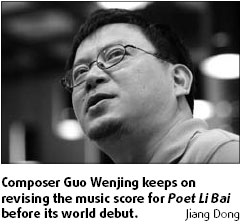
Before the premiere at the Central City Opera, the composer seemed unfazed by Western audience's unfamiliarity with Li Bai at all. There is, Guo stressed, a humanity here.
"We show his frailties, his failings, his desires," he says of the poet. "He is a normal human being. There is a touch of sadness here," Guo admits. "He's lived out his own dream. There is melancholy, but not tragedy."
Foremost in Guo's mind was creating an appreciation among Americans for the words of an ancient Chinese poet. The opera, Guo says, subtly investigates "the contrast between modern man and ancient man, between Chinese and American ideals". "We all have common points, and it's important to share them."
The challenge for the actor is that besides Li Bai, the other three characters - Wine, Moon, and Poem - actually are also Li Bai himself, which reflect the different aspects of his inner psychology.
Taking on the challenge is the basso Tian, an internationally known bass who has performed more than 50 operatic roles and 26 of them at New York's Metropolitan Opera since 1991. "Li Bai is my first title role. After I received this libretto, and especially after we started working on the music and the staging, I found this person more complicated than what I remembered or imagined," Tian says.
It is his long-time dream to sing an opera in Chinese but unexpectedly, singing in Chinese became the most challenging part.
Although he is fluent in Chinese, he primarily sings opera in Italian and French. Adapting to Chinese opera required months of training. "I could feel my throat asking questions," he says.
The singers portraying his sidekicks are equally stellar. Chi Liming brings his clear, agile tenor and an appropriately mischievous spirit to the role of Wine. Peking Opera actor Jiang Qihu excels as Poem. Hailed as "the most open-minded Chinese folk opera singer" by Guo, Jiang has inspired Guo to borrow the folk opera timbers into the opera composition.
