Just for eating and drinking(2)


Tips:
In antiquity wine produced in China was not as we know it today. The fermented product had a thick creamy consistency and was eaten, not being suitable for drinking. Thus the vessels used were more or less the same as those used for other food such as bamboo bowls.
Bronze vessels came into fashion during the Shang Dynasty (16th -11th century BC), and then took on four different forms: there were those that were used for heating their contents, those that would contain a quantity of wine for serving such as jugs or flagons, actual drinking vessels, and those that were used for storage. As well as basic designs there were those that were quite elaborate and which were a symbol of social status. Such vessels were produced in the shapes of the tiger, elephant, rhinoceros, ox or sheep, or anything that demonstrated a high standards of manufacturing skill.
Lacquer vessels became popular in the Han Dynasty (206 BC - 220). As it was customary for people to sit on the floor of their dwellings, the vessels would have been set there for them. This meant that the shapes tended to be low and chunky, often with ear-like handles. Excavation of the Mawangdui Han Tombs revealed some 90 ear-handled cups that are evidence of the artistic skills employed in their production. From the Jin Dynasty (265 - 420) onwards, people would sit on a divan or bed, and this led to the introduction of tall and thin-necked cups.
The design of porcelain vessels produced during the Tang Dynasty (618 - 907) surpassed any that had come before and they were much smaller and more delicate. This material continued to be used until the Ming and Qing Dynasty. Bowls and stoups with their blue and white flower patterns were quite an art.
Aesthetic Vessels
Historically, more unique vessels have been made from special materials such as gold, silver, ivory, jade, cloisonne, and so on. Although they were never in common use, they occupy an important position because of their high artistic value. The following descriptions are of very special wine vessels:
Hejin Bei (Nuptial Wine Cup)
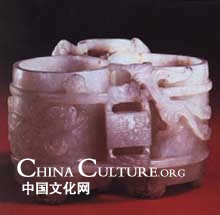
A jade wine cup, named Hejin Bei, was located at Beijing’s Palace Museum. Only 8.3 centimeters in height and 5.8 centimeters in mouth diameter, it was made for emperors' wedding ceremonies in the Ming dynasty by jade master Lu Zigang. Hejin Bei was made up of two interlocking cups, which are bound with rope. The cups share a carved phoenix-shaped handle. Between knots of the rope is a square decoration with the Chinese characters "wan shou," meaning long life.
Each side has a poem in Chinese archaic seal script (zhuan shu) carved in relief. The craftsman engraved his name, Zigang, on the edge of one cup, and incised the following poem: Auspicious clouds accumulate from all directions, Auspicious sun will shine brightly for a thousand springs.

