A tradition thriving tChina's ancient breweries:Towns from the Yangtze to Yunnan province(1)


CHINA'S history of making distilled drinks dates all the way back to the Shang Dynasty (1600-1046 B.C.). Some scholars argue its provenance is more ancient still.
Traditional alcoholic beverages in China fall into two categories – baijiu, or spirits, and huangjiu, or rice wine. Both are made of grains, primarily sorghum and rice. The former is the product of several rounds of distillation, while the latter is directly brewed from the raw materials, and therefore contains less ethanol.
In several provinces breweries have a longstanding reputation. The top-grade baijiu mostly come from Guizhou, Sichuan, Hunan and Shanxi provinces; and no place makes better rice wine than Shaoxing in Zhejiang Province. Since water is critical to the flavour of a brew, most old breweries are located near tributaries in mountainous areas.
Moutai, the National Drink
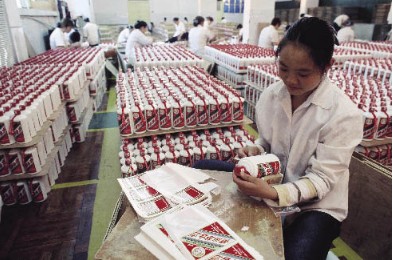
Maotai (Moutai) Town sits by the Chishui River in Renhuai City in northwestern Guizhou Province. The river rises in northeastern Yunnan Province and empties into the Yangtze River after flowing 500 kilometers through Guizhou and Sichuan, thereby supplying water for producers of a dozen famed liquor brands in China.
Sequestered in a steep valley and traversed by a torrential river, Maotai Town is warm in winter and dry in hot summer, a climate that is congenial for microorganisms necessary for fermentation. The Chishui River is crystal clear and greenish blue, as a result of the rich minerals in its water. Industrial plants are banned in the river area to prevent pollution, leaving the water clean for drinking.
The town of four square kilometers sprawls up the mountain like a huge honeycomb. Buildings, tall and low, huddle on the precious level plots of mountain slopes. Of its population of 20,000, half work for the Moutai Distillery Co., Ltd.
Besides the state-owned Moutai Company, there are 400 to 500 distilleries of various sizes in the town, founded by either former company employees or families of current staff members.
The making of Moutai largely follows traditional techniques, which are no secret in the town, and are therefore used in every distillery. With the same source of water and other materials, all local-made liquors are of fair quality. But that of Moutai Co., Ltd. stands above the other brands for the precision manifested in every step of the brewing, better expertise in blending and longer storage.
Liquor shops outnumber businesses of any other kinds in the town. Many of them sell bulk liquor, which is contained in big jars sealed with plastic sheeting. Every jar bears a sticker notifying the content's brand and grade. And a notebook on the wall by the counter displays the price for each of them – ranging from RMB 10 to 360 per kilo.
Yu Jican established a distilling workshop a decade ago. Now its annual production capacity stands at 20 tons, and its cellars have expanded from four to eight. Liquor making is a business where returns come slowly: a brew is good for drinking only after being sealed and kept for at least three years. But the good side is a brew will never decay, and instead grows better in taste with the price rising commensurately with its age.
Yibin, a Living History
Yibin in southern Sichuan Province is the spot where the Minjiang and Jinsha rivers converge into the Yangtze River, and hence it merits the title Number One City on the Yangtze.
When people fly to the city, first thing passengers catch sight of on the ground below is a mega-sized bottle of Wuliangye, the second best known spirit in China after Moutai.
The Wuliangye Group in the city operates in two areas, the old production district in the downtown area and a 10-square-kilometer new district in the suburb, known as the Capital of Liquor, which is open to tourists.
The highest spot in the new production district is the Jiusheng (Liquor Saint) Hill, from which people can look down at the world's two largest brewing workshops and a breathtaking sight of 6,000 fermenting pits at the foot. Beyond them is a 50-meter-tall grain warehouse built in an ancient style. It consists of two rows of 16 colossal white columns sitting on eight platforms and crowned by traditionally designed pavilion roofs. The columns are hollow, and each accommodates as much as 1,250 tons of grain. Next to the warehouse is an ancient pagoda. Below is the century-old Anle (Peace and Joy) Spring, which supplies the factory. A well has been dug at the site, reaching 90 meters downward to the aquifer sustained by the Minjiang River. The gigantic bottle-shaped structure is a complex, its neck forming a water tower, the belly accommodating a power distribution station, and the bottom housing a water pumping station and a test center.
