A tradition thriving tChina's ancient breweries:Towns from the Yangtze to Yunnan province(2)


Despite its massive size and a legion of sleek buildings, the new district has yet to produce liquors as good as those from the old district, which comprises a few old workshops scattered around the city.
One of these workshops is Changfasheng in Gulou Street, one of the best-known Qing Dynasty distillers. It now has 30 fermenting pits, two dating from the Ming Dynasty. Other traces of its hoary past include woodcarvings on its wall decorated in traditional patterns of interlocking flowers and a phoenix with peonies.
Another old workshop is located at the sites of the Qing distilleries Lichuanyong and Deshengfu at the northern city gate. It has 27 fermenting pits, three dating from the early Ming Dynasty. Recent excavations prove that they are among the oldest of their kind in China.
The above two workshops of Wuliangye has been making liquors continually for 600 years, the longest period recorded in China. Their fermenting pits are also the oldest and best preserved.
According to historical records, Sichuan Province was the leading liquor producer and consumer a century ago. Liquor shops first appeared in Yibin in the early Ming Dynasty. They retailed what they brewed. By the Qing Dynasty four distillers – Lichuanyong, Changfasheng, Zhangwanhe and Deshengfu – thrived and purchased 12 fermenting pits that had been in operation since the Ming Dynasty.
Today Changfasheng (meaning Long Prosperity) remains a cluster of low, dimly-lit and moth-eaten wooden huts that were built in the Ming Dynasty. A strong smell of lees infiltrates every room, where most work is done manually to ensure the authentic flavor of the drink.
The Wuliangye Group considered moving the old workshops to its new district, but soon found that their products degraded inexplicably in the new location. "There are more than 20,000 fermenting pits in our new district, which are all covered with sediments from the old pits. In addition, we employ modern technologies to replicate the microorganism condition of the old pits. But to our disappointment, the new pits just cannot produce as good quality liquor as those from the old ones," said He Yu, deputy chief of the company's old district. "Approximately 40 percent of the yields of the old pits are grade one, but the rate is near zero for new pits."
The Wuliangye Group considered moving the old workshops to its new district, but soon found that their products degraded inexplicably in the new location. Hand-made rice wine excels machine-made brew, because its fermentation is done in natural conditions, overseen by experienced brew masters.
Shaoxing, Home of Rice Wine
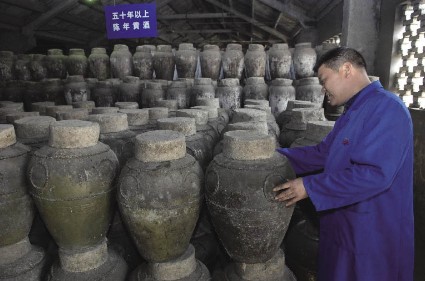
Rice wine is a beige or brown alcoholic drink. The color is the result of chemical reactions between sugar and amino acid, or comes from caramel.
Shaoxing people prefer rice wine, which is lower in alcohol and mellower. "Good rice wine can be shelved for 10, 20 or 50 years, and it grows better with the passage of time. But inferior brews have a short life span," said a local brew master whose favourite is 10-year old rice wine. "After a decade all flavours – sourness, sweetness and fragrance – have fully mellowed and been perfectly mixed and finely soaked by the liquid. Take a sip, whisk it around the mouth before letting it down the throat. That's real enjoyment."
Jianhu Lake, 10 minutes drive from Shaoxing, supplies water for all rice wine producers in the city. Regardless of its shrinking size over the past decades, the quality of its water is largely intact. To illustrate the superiority of Jianhu water, Pan Xinxiang, director of Pagoda Brand Rice Wine Co., Ltd., flipped a coin into a glass of water from Jianhu Lake. The glass was full to the brim. The water surface rose, but not a single drop spilled over the brim. Pagoda is one of the few rice wine breweries that still adhere to traditional manual production. That's why its products have long been ordered by choosy Japanese importers.
According to Mr. Pan, hand-made rice wine excels machine-made brew, because its fermentation is done in natural conditions, overseen by experienced brew masters who closely monitor every step of the process, and make adjustments accordingly.
Gao Xiushui is such a brew master, nicknamed Brew Mind by locals. He started the career as a 16-year-old apprentice and has been in the trade for over 30 years. "Till today I never dared boast that I made the best liquor." For the water, rice and weather vary year to year. "In a cold winter, the period of fermentation has to be longer, and when temperatures are higher, the time has to be shorter," Gao explained, adding, "For the past 30 years I cannot remember any year when the temperature was the same as the previous year, so that I could repeat exactly what I had done earlier." Gao relies on his instinct, attributing every successful year to the "blessing of Heaven."
Dongpu is a town 30 minutes' drive from Shaoxing. It was a brewing center a century ago. Though distillery workshops can no longer be seen today, the tradition of home brewing has continued, and the sight of elders sipping from coarse clay bowls is not uncommon.
Old distilleries have been converted into civil residences, including that of Qing revolutionary Xu Xilin (1873-1907). Stacks of liquor jars still adorn his yard. Every family makes a dozen jars of rice wine every year. They are sealed and stored for one or two years before being served. This milky home brew is free of caramel, but exudes a smell as inviting as those brews manufactured by professional hands.
