China's Bavarian Beach Town(1)


The next time you're in the mood for an ice cold beer and head to Qingdao, a huge city in Eastern China where German settlers built the Tsingtao Brewery, constructed Bavarian-style beer gardens and created an International Beer Festival. FATHOM contributor Adam Graham checks out the scene.
Did you hear the one about the Chinese-German fusion restaurant? An hour after you eat, you're hungry...for power. Two cliches in combination create a third. Still, Qingdao, a former German colony dangling off China's Shandong Peninsula -- and the home to not a few German-Chinese fusion restaurants -- is more of a testament to unpredictable cultural mixes than to the simple addition of stereotypes.
Seven hours north of Shanghai and six hours south of Beijing, Qingdao has made itself a posh summer resort city for China's emerging bourgeoisie, and claims some of the republic's highest living standards. It's nestled on a fertile and hilly crook of land between the Yangtzee and Yellow River deltas and has regular auto ferry service to nearby Japan and Korea.
Also spelled Tsingtao, the modern but soulful metropolis has a complex history that involves a founding by the Dongyi peoples over 6,000 years ago. Next came the mighty Zhou Dynasty (China's longest-running), followed by German and Japanese colonial occupations in the late 19th-century. In 2008, the city experienced a pre-Olympic boom (the sailing regatta was held here) and a subsequent post-Olympic bust, though blocky high-rise construction and commercial developments on the outskirts of town are erecting at a pace that make Westerners nervous. The metro population is already at eight-and-a-half million and growing.
But the city center of this summer resort "town" remains a peaceful enclave and a world away from assembly line China. Any Hamburg native might feel right at home when pulling over Signal Hill in Qingdao's Old Town, graced with cherry blossom trees, quaint red-tiled roofs, and storybook Bavarian and neo-Romanesque architecture. A twin-spired church sits atop a cobbled lane that winds up the densely wooded hill to a gorgeous Bavarian Governor's Mansion (where Mao once stayed) surrounded by observatories and museums. From the blustery summit, a vista of the city's port, its numerous beaches, and wooded parks give way to futuristic skyscrapers in the distance. The image suggests an immense and sprawling Teutonic city -- or perhaps a deferred utopia of the Hanseatic League.
The port city's plan was revised by Hamburg architects in 1897. The city had then been taken over by the Imperial German concession of Jiaozhou Bay after the murder of two German missionaries. Much to the chagrin of 19th-century locals, these city planners laid the final blueprint for Qingdao. But today, Qingdao's architecture heritage is celebrated as part of China's diverse history.
What to Do
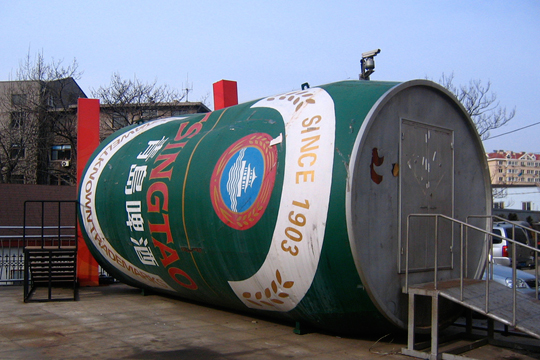
Visit the Tsingtao beer factory, which was built in 1903 and is housed in a manicured red-brick Bavarian house as a testament to the krauts' homesickness for beer. Take the tour of the bottling plant and be sure to enter the "Tipsy Room" -- by turns cheesy and inexplicable. The crooked walls and floors simulate being drunk and are reminiscent of something Bart Simpson might lumber through at Duff Gardens. The beer-tasting room at the end of the tour is a great place to sample the real deal and purchase photos, maps, and other Tsing Tao paraphernalia.
Afterwards, take a step out onto Deng Zhou Road (aka Beer Street) to peruse the brewski-related tschotskes and beer halls that some of the city's 32 million annual tourists experience each year. The city swells for the annual Qingdao International Beer Festival, held the last two weeks of August. In addition to beer, Qingdao is known for its prized mineral water from the legendary Mount Lao Springs, and is also one of China's four ancient sea salt zones. Chardonnays and Rieslings from Huadong Winery, just 20 minutes away, are becoming increasingly reputable among wine aficionados.
The city's six beaches are the main summer draw. Unfortunately, trash is a problem at some of them, and last year saw an outbreak of blue-green algae bloom (though a naturally occurring phenomenon, it doesn't exactly make for ideal swimming conditions). Nevertheless, summer weekends in Qingdao's city beaches bulge with crowds. The cleanest, least populated ones can be found from Zhanqiao Pier to Shilaoren Beach in the eastern suburbs. Laoshan Beach (at the entrance to Laoshan National Park, about a 30 minute drive east of the city limits) is one of the most beautiful in the region and sits under the protection of the verdant Taoist holy mountain, Lao Shan, which contrasts nicely against golden sand.
