China's Bavarian Beach Town(2)


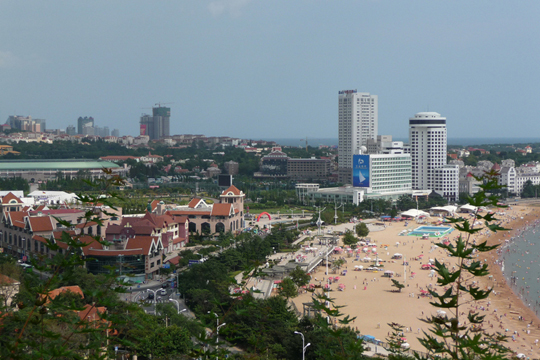
The clean, broad, and surfable Old Stone Man Beach is another one within close proximity to the city. Beaches 1, 2, and 3 are crowded with locals but not always the most pristine. Starting from (Taipingqiao) Cape of Peach, the most beautiful sections of the beach include Fushan, Zhanshan, Taipingshan, and Huiquanjiao. The warm water and soft sand make it ideal for sunbathing and swimming. Leafy Lu Xun Park is an ideal seaside picnic grounds called "a fairyland by the sea" by beloved Tang Dynasty poet Li Bai.
The city's fashion district (Minjiang) is a great place to explore real everyday Chinese life. Yes, there's a Wal-Mart and Starbucks, not to mention a slew of luxury stores like LV, Gucci, Prada, Carrefour, and Hermes. Nobody loves luxury brands more than the Chinese, regardless of their authenticity. Jimo Lu market is the Canal Street of Qingdao, and the best spot to score knock-off designer goods for cheap.
An increase in population has meant the clean-up of shanty towns, a refurbished Commercial Street in the Shi Bei District, and a freshly painted and picturesque Tai Dong Street. Qingdao Atrium City is an old work shop converted into a sort of a nocturnal canopy of dining and entertainment venues. Most interesting is the development of Wine Street, capitalizing on the area's promising wine future and sure to put Qingdao's vines on every oenophile's radar.

Where to Stay
Major four and five star hotel chains have unfurled all over Qingdao. Most notable is the service-forward Shangri La -- it is hands down the best bed in town. Be sure to get in on the complimentary breakfast at uber-modern Café Yum, stocked with every genre of cuisine you can imagine. Breakfast alone has a Japanese miso station, a stir fry and noodle wok, a western spread including crisped bacon, beef wellington, and an omelet station, twelve different juices including kiwi and strawberry, dozens of sweet breads and fruits, dim sum, and two six-foot pots of congee.
Head to the concrete Zhanqiao Pier originally built in 1890 by Emperor Guan Xu. There's an ornately carved two-story octagonal wooden pagoda called the Wave Stopping Pavilion, particularly popular among romance-seekers when moonlit. The walk to the pier is filled with vendors selling everything from sausage to illegal red coral. To actually stay on the beach, check in to Seaview Garden Hotel, an expansive quasi-Victorian property which offers sweeping views of the water and impeccable service, and is ranked the number one Qingdao hotel on Tripadvisor.com.
What to Eat
Foodies should note that there's a real stratification to the food in China. In total, there are eight principal cuisines and Qingdao's falls under the Shandong umbrella but in the Jiadong style, one of two culinary regional methods within Shandong. Like many coastal Chinese areas, seafood is a mainstay. The Yi Qing Lou Seafood Restaurant is a vegetarian's worst nightmare. Before you sit down at your table, you are guided by pink fur-clad hostesses through a cold stock cellar, which is equal parts zoo and kitchen. There, you choose your meat from a selection of live rattlesnakes, crabs and turtles, filet of alligator, shark fin, sea urchin, rabbit, or giant prawns. Monnemer Eck's is a lively German restaurant frequented by ex-pats, locals, and tourists in the mood for bratwurt, schnitzel, and draft beer. It's the ideal place to tell your German-Chinese fusion joke.
Good to Know
Unlike many rapidly developing cities in China, Qingdao, which means The Blue-Green Island in Cantonese, is positioning itself as an eco-leader in China's industrialized east. After all, its success as a tourist destination relies on cleaner beaches, safer water, and an overall healthier environment. The city has been greening itself and continues to exceed the conditions found 50 years ago.
