How to Buy ...(1)


Wine Futures
By Robert Bohr
The futures market exists only in Bordeaux. Buyers need to compare the track records of great vintages from the various châteaux. What’s going to drive the wine’s future value is how well it was scored by experts in relation to vintages in its immediate age range. Weather conditions also play a role: not too hot, not too cold, not too humid, not too dry, not too windy. About three times a decade wines hit this kind of sweet spot where they’re really great. Next, you need to make sure that whatever international retailer you’re buying from has a history of actually delivering the goods, even if it means paying a bit more. Also, you’d like the shipping conditions to be ideal, that is to say refrigerated, so you don’t end up with a damaged product. You have the ability to request certain bottle sizes. If your spouse doesn’t drink wine, half-bottles are great. If you’re someone who likes to entertain, large bottles are a possibility. Magnums and half-bottles carry a premium on the secondary market. Magnums are also ideal aging vessels.
All this said, I’m not buying wine futures, because prices have gone crazy since about 2005. There has been a huge rise in global demand, particularly from China. It’s gotten so I can buy a case of 1982 Mouton Rothschild that’s perfectly mature for less money than 2009 futures of the same wine, which I won’t be able to drink for 20 years. — Bohr is wine director at Grand Cru Wine Consulting.
A Dinosaur
By Henry Galiano
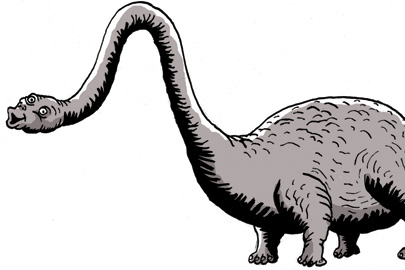
Illustration by Neal FoxPaying $3.5 million for a Brontosaurus or $9 million for a T. rex is not a lot of money for what you’re getting. I mean, some Picassos go for $40 million, and that’s just a piece of cloth canvas with some oil paint. In the future, dinosaur prices will go through the roof because the U.S. is one of very few places where you can legally buy a dinosaur, and demand is shooting up. If a museum in China wants a dinosaur, they buy it from the U.S. If you’re buying a dinosaur as an investment, get in touch with a reputable supplier. They’ll give you a menu of available fossils. I’d probably get something small enough to house or store, like a Camarasaurus. Next, get a lawyer to make sure you get the legal titles from the property owner, the company you’re buying from, the company that’s cleaning and prepping the fossil, and from your broker. And get documentation: osteological reports, photographs, GPS readings that say exactly where the bones were found, information on what other dinosaurs were found with it, geological reports, and what people dug there. Some companies will sell the dinosaur and also clean it, mount it, stabilize it, and articulate it. Fossils usually require reconstruction, and it matters how the gaps are filled, how the paints are blended, how anatomically accurate everything is. Hiring a paleontologist to assess the work is a good idea. — Galiano is director of Dinosauria International.
