Chinese wines are 'average' ... let's break out the champagne!
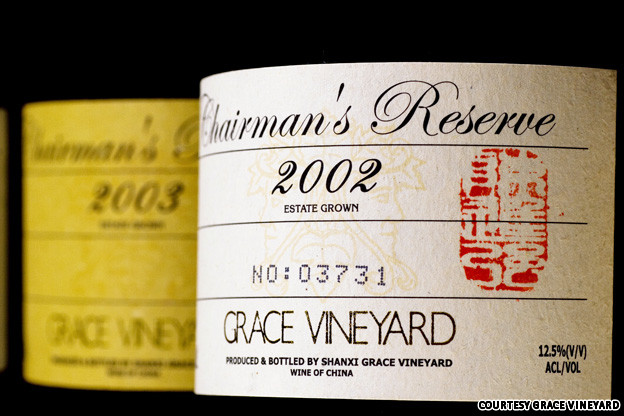
On Robert Parker's wine website, vino expert Lisa Perrotti-Brown reviewed 20 Chinese wines from Grace Vineyard, Dynasty and Silver Heights (the smallest producer of the bunch and the least well-known even domestially) -- amazingly enough, 18 passed the taste test as at least "average."
Score one for Chinese wines.
- More on CNNGo: Pairing wine with Chinese food -- it can be done
The Grape Wall of China picked up the ratings, noting that nine wines scored from above average to good (80-89 points out of 100), and another nine came in at the 70 to 79 point range (average).
At this point, and with a rather lackluster reputation for Chinese wines, the industry should be well pleased with “average” and run with it.
Perrotti-Brown did stack the glasses a bit in China’s favor as Grace Vineyard and Silver Heights are really the only two vineyards in China of international note, posts Jim Boyce.
How Dynasty passed, we aren't so sure.
The top two ranking wines were Grace's Chairman’s Reserve (RMB 488) at 85 points and Grace's Deep Blue (RMB 288), which came in at 82 points.
Grace Vineyard also produced the only two bottles that didn’t pass the 70 point mark, the Grace Premium Cabernet Sauvignon Merlot (2008) and the Grace Cabernet Sauvignon (2008).
Although Chinese wine only fared marginally well on this recent international taste test, the demand for Chinese wine is increasing. China produced 72 million cases of wine in 2009, an increase of 28 percent from 2008, according to a recent report by French wine exhibition organizers Vinexpo.
If China keeps producing wine at its current growth rate, the country will generate 128 million cases of wine by the end of 2012, an increase of 77 percent that would see it overtake more established New World wine nations such as Australia, which has a forecast of 121 million cases.
- More on CNNGo: Can Shanghai become a fine-wine capital?
Much of this growth in the demand for Chinese wine though comes from the domestic market.
"Some Chinese labels have exhibited internationally and sold a tiny amount of wine,” says Denis Gastin, a commercial wine writer who regularly travels to China.
“But that is not the focus of the industry at the moment. The motivation was more to show Chinese drinkers local growers could compete internationally.”
- “中国梦·世界情”中国品牌全球行北京首发盛大启航
- 5-29
- 雷雁
- 毛铺苦荞酒获“白酒国家评委感官质量奖”
- 8-18
- 童国强
- 这些地方招人,博大酒水人才网带你去看看!
- 5-29
- 第93届全国糖酒会为何选择南京——专访全国糖酒会办公室主任古平
- 5-29
- 孙文东
根据《中华人民共和国著作权法》及《最高人民法院关于审理涉及计算机网络著作权纠纷案件适用法律若干问题的解释》的规定,本网站声明:
凡本网注明“来源:《华夏酒报》”或“来源:中国酒业新闻网”的所有作品,版权均属于华夏酒报社和中国酒业新闻网,未经本网授权不得转载、摘编或利用其它方式使用上述作品。已经本网授权使用作品的,应在授权范围内使用,并注明来源:《华夏酒报》或中国酒业新闻网。违反上述声明者,本网将追究其相关法律责任。
凡本网注明来源:XXX(非中国酒业新闻网)的作品,均转载自其它媒体,转载目的在于传递更多信息,并不代表本网赞同其观点和对其真实性负责。我们力所能及地注明初始来源和原创作者,如果您觉得侵犯了您的权益,请通知我们,我们会立即改正。
如因作品内容、版权和其它问题需要同本网联系的,请在30日内进行。 如果您有任何疑问,请联系我们:wlb@hxjb.cn
 互联时代,酒类电商的明日走势
 一购三赢?详解青青稞酒并购“中酒网”
 华夏酒报荣获中国商业文化建设传播奖
 三条酒类广告禁令考量社会责任