Boxed wines are so last decade.So one vintner is reaching even further back with barrel wines
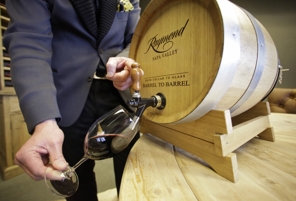
The Associated Press - This Friday, Feb. 25, 2011 photo shows a vacuum packed container of wine inside a barrel-to-barrel dispenser at Raymond Vineyards in St. Helena, Calif. Boisset Family Estates runs DeLoach Vineyards in the Russian River Valley region of Sonoma County, which has been selling what they call the barrel-to-barrel concept for more than a year, and recently launched the program at the company’s St. Helena-based Raymond Vineyards. (AP Photo/Eric Risberg)
Selling wine by the glass is hot, but having half-empty bottles left over is not, something that has prompted restaurants and bars to explore new delivery systems from sophisticated preservation devices to kegs that keep wine on tap.
One of the latest variations on the theme has a back-to-the-future aspect: The wine is packaged in plastic bags similar to those used in boxed wines, but in this case the bag is housed in an elegant wooden barrel.
“This is the reinterpretation of history,” says Jean-Charles Boisset, president of Boisset Family Estates. “We wanted to create something very unique for restaurants and hotels and eventually for someone at home.”
Boisset Family Estates runs DeLoach Vineyards in the Russian River Valley region of Sonoma County, which has been selling what they call the barrel-to-barrel concept for more than a year, and recently launched the program at the company’s St. Helena-based Raymond Vineyards.
As with boxed wines, the bag-in-barrel approach comes with the advantage of not having to ship and recycle glass bottles. And the wine stays fresh longer. According to Boisset, the unfilled 10-liter bag weighs about 68 grams, 99 percent less than a nine-liter case of empty glass bottles.
So far, about 800 of the 10-liter barrels have been shipped to restaurants and bars. DeLoach also recently introduced a 3-liter version for home use. The Raymond wine, a cabernet sauvignon, is available only in the 10-liter size for now.
At Chicago-based Wildfire Wine & Spirits, a small chain of steak-and-seafood restaurants, director Brad Wermager said he was drawn to the concept because it was different and “we liked the idea that it was good for the environment.”
Wildfire has 30 wines available by the glass and Wermager has considered buying wine in kegs, which is another way to save on bottle waste. He likes the fact that the barrel is something that can be put on display. “It’s a good conversation piece,” he says.
Bag-in-box wines have come a long way since the days when they were mostly the punch line to jokes. Many have won high praise and they’re becoming a more common sight on store shelves.
Still, Raymond winemaker Stephanie Putnam admits she had some qualms about the new packaging.
“Of course I did,” she says with a laugh. “But I think we have really worked hard on trying to keep the wine as fresh as possible. We’re bottling the wine every three months, that way we’re really keeping it fresh and vibrant for the consumer.”
At the Captain’s Tavern in Miami, Bill Bowers who owns the restaurant with wife Audrey, put the DeLoach barrel in about four months ago and “we’ve had good luck with it,” he says.
The only problem is that due to state regulations he can only get the 3-liter bags, which means on a busy night the bag has to be changed and, when the level drops, the glass can take a while to fill. Still, “the quality of the wine is excellent and the taste of the wine is excellent and people like it very much,” he says.
Leslie Sbrocco, wine author and founder of ThirstyGirl.com sees the bag-in-barrel program as part of a general evolution of wine packaging as the industry and consumers have gotten used to more than the traditional bottle and cork.
In addition to wine-on-tap systems for commercial and at-home settings, boxed wine companies have upgraded the design of packaging, with a few companies opting for reusable wooden boxes.
“The container is becoming less of an issue and the only way it is an issue is if we get a, ‘Wow, isn’t that cool!’ response,” says Sbrocco. “It’s cool that there’s a plastic bottle or it’s cool if there’s wine on tap or it’s cool if there’s wine in a can. That is the changing mindset of wine consumers.”
- “中国梦·世界情”中国品牌全球行北京首发盛大启航
- 5-29
- 雷雁
- 毛铺苦荞酒获“白酒国家评委感官质量奖”
- 8-18
- 童国强
- 这些地方招人,博大酒水人才网带你去看看!
- 5-29
- 第93届全国糖酒会为何选择南京——专访全国糖酒会办公室主任古平
- 5-29
- 孙文东
根据《中华人民共和国著作权法》及《最高人民法院关于审理涉及计算机网络著作权纠纷案件适用法律若干问题的解释》的规定,本网站声明:
凡本网注明“来源:《华夏酒报》”或“来源:中国酒业新闻网”的所有作品,版权均属于华夏酒报社和中国酒业新闻网,未经本网授权不得转载、摘编或利用其它方式使用上述作品。已经本网授权使用作品的,应在授权范围内使用,并注明来源:《华夏酒报》或中国酒业新闻网。违反上述声明者,本网将追究其相关法律责任。
凡本网注明来源:XXX(非中国酒业新闻网)的作品,均转载自其它媒体,转载目的在于传递更多信息,并不代表本网赞同其观点和对其真实性负责。我们力所能及地注明初始来源和原创作者,如果您觉得侵犯了您的权益,请通知我们,我们会立即改正。
如因作品内容、版权和其它问题需要同本网联系的,请在30日内进行。 如果您有任何疑问,请联系我们:wlb@hxjb.cn
 互联时代,酒类电商的明日走势
 一购三赢?详解青青稞酒并购“中酒网”
 华夏酒报荣获中国商业文化建设传播奖
 三条酒类广告禁令考量社会责任