Spanish Viticulturists Working with WSU Scientists to Further Understanding of Vineyard Irrigation Management
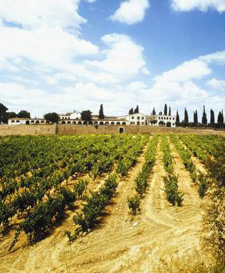
The rain in Spain stays mainly on the plain: like eastern Washington State, much of Spain is arid and grape growers use irrigation to supply vines with just enough water to produce grapes of very high quality.
Pascual Romero, a visiting scientist at WSU’s Irrigated Agriculture Research and Extension Center in Prosser, is the lead author of this year’s Best Paper in Viticulture award from the American Journal of Enology and Viticulture.
Romero shares the award with co-authors and researchers Jose Ignacio Fernández-Fernández and Adrián Martinez-Cutillas of Instituto Murciano de Investigación y Desarrollo Agrario y Alimentario, for their paper titled “Physiological Thresholds for Efficient Regulated Deficit-Irrigation Management in Winegrapes Grown under Semiarid Conditions.”
The subject of the paper, deficit irrigation, highlights the fact that a new leaf is being turned in our understanding of how irrigation affects the physiology of grapevines. In much of Europe, it’s still illegal to irrigate wine grapes after veraison. Veraison, originally a French term, refers to the change of color that occurs in grape berries as they begin to ripen. Because of ancient traditions, rather than science, growers aren’t allowed to irrigate post-veraison for fear of diluting Brix (the measure of the fruit’s sugar content).
For over 20 years, the working assumption has been that berries are hydraulically isolated after veraison, that is, that no water from the roots enters the berries. Recent research by Chateau Ste. Michelle Distinguished Professor of Viticulture Markus Keller and others at WSU’s Irrigated Agriculture Research and Extension Center in Prosser, though, proves that berries are not isolated and that late-season irrigation does not dilute Brix. In fact, Keller said, if done correctly, irrigation accelerates ripening.

Pascual Romero
“That said, we need lots more research on the effects of irrigation on grapevine physiology,” Keller said.
Romero and his colleagues’ paper begins to address precisely that need. Building on research conducted by Keller and many others, the Spanish scientists found that regulated deficit irrigation (RDI) requires a thorough understanding of “several threshold values for plant stress indicators.” The goal of their two-year RDI project was to gain some insight into how much water could be applied, and when, to “control excessive vegetative development, reduce berry size, and to stimulate the direct accumulation of anthocyanins and other phenolic compounds by post-veraison water deficit.”
To that end, Romero and his collaborators investigated two RDI regimes in order “to identify physiological thresholds for efficient long-term RDI strategies for premium red wines and to improve water use efficiency under semiarid conditions.” They found that a moderate RDI regime was beneficial for factors such as increased Brix and phenolic composition while a much stricter one seriously stressed the plants. The stricter regime reduced fruit quality and actually damaged the vines. This research proposed a range of optimum values of several physiological indicators in order to avoid severe vine damage and to improve phenolic composition and water use efficiency in Mourvedre grapevines. Dangerous thresholds of these physiological parameters were also identified for this variety.
Better knowledge of the contribution of late-season irrigation and water stress to variations in berry size and fruit quality will lay the foundation for better vineyard irrigation management. In semiarid regions like Spain and eastern Washington, that is crucial information because water use affects producers’ economic bottom line.
Now, Romero and Keller are working together to further their understanding of irrigation management in vineyards. “During my year at WSU, my main goal is to learn more about grapevine water relations, especially hydraulic limitations and grape water relations, and deficit irrigation in this dry climate that is so conducive to irrigation viticulture,” Romero said. “I want to study the techniques, tools and approaches used in Keller’s lab to measuring the vines’ responses to water deficit.”
In addition, Romero will participate in ongoing irrigation research in collaboration with Keller’s graduate students, WSU enologist Jim Harbertson, and researchers at Ste. Michelle Wine Estates, which seeks to fine-tune 文章来源中国酒业新闻网deficit irrigation in order to maximize fruit and wine quality. Romero said that another goal is to initiate some collaborative research between Washington and Spain, both of which have many similar issues in terms of water deficit and irrigation and grapes.
转载此文章请注明文章来源 中国酒业新闻网。
- “中国梦·世界情”中国品牌全球行北京首发盛大启航
- 5-29
- 雷雁
- 毛铺苦荞酒获“白酒国家评委感官质量奖”
- 8-18
- 童国强
- 这些地方招人,博大酒水人才网带你去看看!
- 5-29
- 第93届全国糖酒会为何选择南京——专访全国糖酒会办公室主任古平
- 5-29
- 孙文东
根据《中华人民共和国著作权法》及《最高人民法院关于审理涉及计算机网络著作权纠纷案件适用法律若干问题的解释》的规定,本网站声明:
凡本网注明“来源:《华夏酒报》”或“来源:中国酒业新闻网”的所有作品,版权均属于华夏酒报社和中国酒业新闻网,未经本网授权不得转载、摘编或利用其它方式使用上述作品。已经本网授权使用作品的,应在授权范围内使用,并注明来源:《华夏酒报》或中国酒业新闻网。违反上述声明者,本网将追究其相关法律责任。
凡本网注明来源:XXX(非中国酒业新闻网)的作品,均转载自其它媒体,转载目的在于传递更多信息,并不代表本网赞同其观点和对其真实性负责。我们力所能及地注明初始来源和原创作者,如果您觉得侵犯了您的权益,请通知我们,我们会立即改正。
如因作品内容、版权和其它问题需要同本网联系的,请在30日内进行。 如果您有任何疑问,请联系我们:wlb@hxjb.cn
 互联时代,酒类电商的明日走势
 一购三赢?详解青青稞酒并购“中酒网”
 华夏酒报荣获中国商业文化建设传播奖
 三条酒类广告禁令考量社会责任