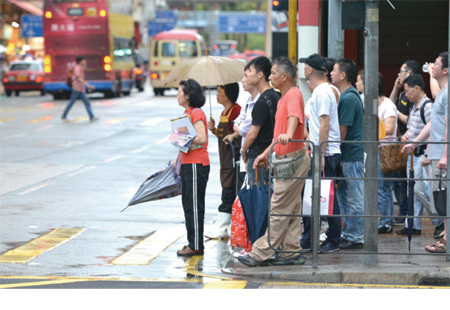
Pedestrians on Nathan Road, Tsim Sha Tsui. Photo Provided by Red Door News, Hong Kong
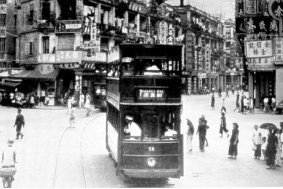
Johnston Road in the 1950s. Photo Provided by Red Door News, Hong Kong
Despite soaring vehicle ownership and congested streets, Hong Kong's road accident death toll last year fell to the lowest level for 56 years. But some road safety campaigners warn against complacency and say still more needs to be done to keep death rates down, reports Simon Parry.
The year was 1954. The Austin A40 and the Hillman Minx were among the most popular cars on the road. That was the last year that Hong Kong recorded a traffic fatality near to the decades low rate recorded last year.
Hong Kong's 2010 road accident death toll of 117 was the lowest for 56 years and appears to be testament to a remarkable improvement in road safety that has given Hong Kong the right to claim some of the safest streets in the world.
The number of people killed annually in road accident in Hong Kong is now around 17 in one million, just 9 percent of the global average of 188 in one million, according to government calculations.
Regionally, Hong Kong's roads are less deadly than Singapore's where the ratio is around 38 deaths per million population and Seoul where the ratio is around 48 deaths per million population. Further afield, Greater London records 27 deaths per million population and Hamburg 23.
What makes the death toll of 117 last year all the more laudable is that it was achieved in a year when the number of vehicles on the road is around 600,000 - 15 times more than the 40,000 registered vehicles in 1954 when streets were so quiet comparatively that the city's first set of traffic lights had been installed only one year earlier.
When you take into account the city's far smaller population in 1954, the death rate per million population in that year was 45, meaning the death rate per head of population has declined 62 percent in the intervening years.
The biggest decline has come in the past 30 years which has seen the annual road death rate plummet from a peak of almost 500 in 1973 following a boom in car ownership through the 1960s and early 1970s.
The figures certainly appear impressive but not everyone is celebrating and some of the city's road safety campaigners like David Lorimer feel not enough is being done to keep death off the roads.
"Two people still die on Hong Kong's roads every week," Lorimer pointed out. "If we had two people dying in plane crashes at Chek Lap Kok every week, no one would use the airport."
Assistant Commissioner for Transport Leung Tak-fai told China Daily one of the most important factors in bringing the death rate down had been the efforts taken to reduce accidents involving pedestrians.
In 1980, the number of accidents involving pedestrians was 8,340. In 2010, there were 3,591 - a reduction of 4,749 accidents or 56.9 percent. Over the same period, the number of pedestrians killed or seriously injured in accidents fell from 3,596 to 813, a 77 percent drop.
The introduction of pedestrian crossings with signals had been one of the biggest factors in reducing accidents involving pedestrians, Leung said. From the first traffic light in Nathan Road in 1953, there are now 1,788 junctions with signal lights, most of them with pedestrian crossings.
Since the late 1980s, yellow bar markings have been introduced at signal light crossings and pedestrian railings have been made less easy to step through or jump over, keeping more people away from dangerous stretches of road.
The number of foot bridges and subways has also increased from 422 in the early 1990s to 1,169 today, excluding ones built by private developers.
Another major factor, said Leung, was ongoing legislation. "I think the most significant one is the introduction of seat belt legislation in the 1983," he said, pointing to statistics that showed a 35 percent reduction in drivers killed or seriously injured in traffic accidents in the two years before and after the legislation.
In the 1990s, drink-drive legislation helped bring accident tolls down further and the later tightening of blood-alcohol limits saw a 9 percent reduction in accidents involving drink-driving, Leung said.
Perhaps one of the biggest albeit harder to quantify changes has been in people's attitudes. "We can't ignore the effect of road safety publicity and education," Leung said.
"We have used the mass media such as radio and TV and modern media like the Internet and Facebook and YouTube. That has helped us publicize road safety messages as well as to influence behavior.
"Nowadays, when friends come to dinner, if they are driving they will usually refuse to drink even one glass of beer. There has been a change in attitudes. People don't see it is a shame (that they can't drink). They feel quite proud because they are being responsible drivers and they will say 'I drive so I don't drink'."
Whether the lowering death toll means Hong Kong people are better drivers than they used to be is a different matter.
"I think not so much skills but the behavior of drivers over the years has changed a lot," said Leung.
"If you see the behavior of drivers in other places, you will notice that comparatively our drivers are more patient, more law-abiding and they respect each other.
"I wouldn't say it is perfect but I have noticed there has been quite significant progress and improvement in driving behavior."
Ian Foster, general secretary of the Hong Kong Automobile Association, said a noticeable toughening up of enforcement on speeding drivers may have had an impact on the falling death rate, as well as the quality of modern cars.
"The police in Hong Kong do seem to be extremely tight on speeding these days," he said.
"I am very, very cautious now even letting my car creep five miles per hour over the speed limit."
He added: "Unlike other countries the majority of cars on Hong Kong roads are relatively new, with air-bags and other safety features fitted as standard. So a serious crash which would previously have meant death now might result in severe injuries but avoid the loss of life."
Julian Kwong, founder and chairman of the independent organization Community for Road Safety, said the Hong Kong government's efforts had played "an important role" in the decrease in fatalities and acknowledged the figures were now lower than for many other world cities.
However, Kwong, who has worked as a road safety consultant for Asian Development Bank highway projects in China and Bhutan, said: "We are still talking about a large number of victims. Over the last 10 years alone, we have had 1,581 road users killed and almost 200,000 injured. We must remember that every fatal and severe road crash is violent and tragic."
The pedestrian fatality rate in Hong Kong was 0.99 victims per 100,000 population in 2010, still way above that of the best performing country the Netherlands which recorded a rate of 0.42 victims per 100,000 population in 2008, Kwong pointed out.
Speeding and pedestrian safety should be more vigorously tackled, he argued.
"Every year, 30 percent of pedestrian casualties happen on footpaths or traffic islands," Kwong said. "Senior citizens are very vulnerable on our streets and we have an ageing population."
Independent tests showed speeding was still widespread.
"We recorded speeds as high as 71 km/h on the main street of Queen's Road East during the daytime and 48 km/h on the bustling minor streets of the Flower Market. While a fair number of drivers are behaving reasonably, some are just way of out the safety margin," he said.
Lower speed limits are needed to bring accident rates down further and a change of thinking needed to work towards this goal, according to Kwong. Speed limits on busy main streets should lowered to 40 km/h and minor streets should have 30 km/h limits, he suggested.
"Society does not yet see excessive speed on streets as a problem as is more inclined to blame pedestrians," he said.
"The government is still clinging to the 'blame the victims' approach which was the mainstream thinking of the 1950s and 1960s in the developed world. Such an approach is not necessarily fair and often aggravates the pain of victims. After all, we use roads for daily life. They are not war zones."
Kwong also pointed to "prevalent safety weaknesses" in major road projects over the past 30 years, including poor merging designs, hidden exits and poor signage.
"All these went unchecked simply because we did not deploy the right expertise and there was not a strict audit procedure," he said.
"The past 10 years saw a number of severe accidents, including two of the worst in Hong Kong's history. Overall, we can still do much better in the safety of road infrastructure."
A more visionary approach with innovative solutions was needed if Hong Kong was to further improve its road safety, Kwong argued.
"We want to see road safety at its best in Hong Kong serving as a model for the region," he said.
"Hong Kong needs both a bold vision and attainable targets. Government leadership is vital."
David Lorimer, founder and director of the Hong Kong Society for the Protection of Public Health, said Hong Kong should appoint a commissioner for road safety, implement speed control technology in 50 km/h zones to ensure enforcement of existing speed limits and ban modified and race-tuned cars to stop the menace of road racers.
The falling road death rate had "very little to do with the government" and was more because of improvements in emergency medical care, improved technology for traffic law enforcement like speed cameras and guns, and modern vehicle engineering, Lorimer argued.
Meanwhile, problems continued largely unchecked on roads with high accident rates like Nathan Road and police officers could be seen ignoring traffic legislation on Hong Kong's roads on a daily basis, he claimed.
"You would only have to follow a police motorcycle for about two minutes before you would witness the drive committing one offence or another," Lorimer said.
However, Leung said the government was constantly looking at ways to drive forward road safety improvements in Hong Kong to further reduce the rate of fatalities. New legislation should be introduced later this year or early in 2012 to outlaw driving under the influence of drugs, identified as a growing cause of accidents.
"We will continue our efforts in the past which have proved to be successful," he said. "We will continue to promote our three-pronged approach - to improve or enhance legislation as well as focus on enforcement, improve transport infrastructure such as pedestrian facilities and thirdly to enhance our publicity and education to influence the behavior of drivers, passenger and pedestrians."
Hong Kong is not yet the world's safest city in terms of traffic fatalities - Tokyo, Berlin and Stockholm have marginally lower per capita death rates - but the 50-year low achieved in 2010 may provide the inspiration and opportunity to make the city's roads safer yet.
What is at issue as far as some road safety campaigners are concerned is whether the approach being taken by the Hong Kong to reducing accident rates is visionary and progressive enough to seize that opportunity.
- “中国梦·世界情”中国品牌全球行北京首发盛大启航
- 5-29
- 雷雁
- 毛铺苦荞酒获“白酒国家评委感官质量奖”
- 8-18
- 童国强
- 这些地方招人,博大酒水人才网带你去看看!
- 5-29
- 第93届全国糖酒会为何选择南京——专访全国糖酒会办公室主任古平
- 5-29
- 孙文东
根据《中华人民共和国著作权法》及《最高人民法院关于审理涉及计算机网络著作权纠纷案件适用法律若干问题的解释》的规定,本网站声明:
凡本网注明“来源:《华夏酒报》”或“来源:中国酒业新闻网”的所有作品,版权均属于华夏酒报社和中国酒业新闻网,未经本网授权不得转载、摘编或利用其它方式使用上述作品。已经本网授权使用作品的,应在授权范围内使用,并注明来源:《华夏酒报》或中国酒业新闻网。违反上述声明者,本网将追究其相关法律责任。
凡本网注明来源:XXX(非中国酒业新闻网)的作品,均转载自其它媒体,转载目的在于传递更多信息,并不代表本网赞同其观点和对其真实性负责。我们力所能及地注明初始来源和原创作者,如果您觉得侵犯了您的权益,请通知我们,我们会立即改正。
如因作品内容、版权和其它问题需要同本网联系的,请在30日内进行。 如果您有任何疑问,请联系我们:wlb@hxjb.cn
 互联时代,酒类电商的明日走势
 一购三赢?详解青青稞酒并购“中酒网”
 华夏酒报荣获中国商业文化建设传播奖
 三条酒类广告禁令考量社会责任