Huangjiu is either drunk directly after being cooled or warmed, or used in Chinese cooking. Major producers of huangjiu include mainland China and Taiwan.
Chinese "yellow liquors" (fermented wines) are classified based on several factors. Among them are the liquor's dryness, the starter used in its production, and its production method.
Classification
Chinese Liquor Huangjiu are classified based on several factors. Among them are the liquor's dryness, the starter used in its production, and its production method.
Dryness/Sweetness
This is the formal classification for all Chinese wines. There are five categories: dry, semi-dry, semi-sweet, sweet, and extra-sweet:
-
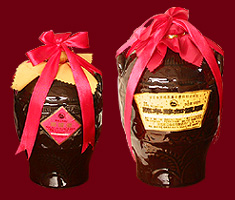
Dry: with sugar content no greater than 1%. This type of yellow wine has the lowest fermentation temperature. An example of this kind is Yuanhongjiu, a specialty of Shaoxing, so-named because traditionally the wine jars are painted red.
-
Semi-dry: with sugar content between 1% and 3%. This type of huangjiu can be stored for a long period of time and encompasses most of the varieties of huangjiu that are exported from China. An example of this variety is Jiafanjiu, a variation on the Yuanhongjiu that involves adding more rice in fermentation. The jiafanjiu is traditionally used for ceremonies, such as child birth, engagement, and funerals.
-
Semi-sweet: with sugar content between 3% and 10%. The longer the semi-sweet huangjiu is stored, the darker its color becomes. This variety of huangjiu cannot be stored for long periods of time. An example of this kind is Shanniangjiu, a specialty of Shaoxing which partly uses vintage Yuanhongjiu instead of water.
-
Sweet: with sugar content between 10% and 20%. An example of this variety is Feng Gang Jiu. In comparison to previous types of huangjiu, sweet huangjiu can be manufactured all year round when using traditional production methods.
-
Extra-sweet: with sugar content equal or greater than 20%. An example of this variety is Xiang Xue Jiu.
Starter/Inoculant
-
Small starter: Wines inoculated using rice cultured with Rhizopus, yeast, and other bacteria. The mixture generates less heat, so they are mostly used in the tropical South of China.
-
Large starter: Wines inoculated using rice cultured with Aspergillus oryzae and yeast. Almost all famous alcoholic drinks in China belong to this type.
-
Red starter: Wines that are flavoured and coloured with Monascus purpureus or other red rice molds of the Monascus genus.
Production methods
-
Hot rice: The steamed rice used to make the wine is cooled in the open air until it is still relatively warm before processing.
-
Cool rice: The steamed rice used to make the wine is quenched with cold water before further processing. The unfiltered mash for this wine is sometimes eaten as a dessert or used as an inoculant for other Chinese wines.
-
Feeding rice: Steamed rice is continuously fed into a fermenting mixture (up to three times), which produces a sweeter wine.
-
Fortified: Distilled Chinese wines are added to the fermenting mash, which increases the concentration of alcohol in the mash and halts the fermentation process. This leaves a significant quantity of unfermented sugars, thus producing an especially sweet tasting wine.
- “中国梦·世界情”中国品牌全球行北京首发盛大启航
- 5-29
- 雷雁
- 毛铺苦荞酒获“白酒国家评委感官质量奖”
- 8-18
- 童国强
- 这些地方招人,博大酒水人才网带你去看看!
- 5-29
- 第93届全国糖酒会为何选择南京——专访全国糖酒会办公室主任古平
- 5-29
- 孙文东
根据《中华人民共和国著作权法》及《最高人民法院关于审理涉及计算机网络著作权纠纷案件适用法律若干问题的解释》的规定,本网站声明:
凡本网注明“来源:《华夏酒报》”或“来源:中国酒业新闻网”的所有作品,版权均属于华夏酒报社和中国酒业新闻网,未经本网授权不得转载、摘编或利用其它方式使用上述作品。已经本网授权使用作品的,应在授权范围内使用,并注明来源:《华夏酒报》或中国酒业新闻网。违反上述声明者,本网将追究其相关法律责任。
凡本网注明来源:XXX(非中国酒业新闻网)的作品,均转载自其它媒体,转载目的在于传递更多信息,并不代表本网赞同其观点和对其真实性负责。我们力所能及地注明初始来源和原创作者,如果您觉得侵犯了您的权益,请通知我们,我们会立即改正。
如因作品内容、版权和其它问题需要同本网联系的,请在30日内进行。 如果您有任何疑问,请联系我们:wlb@hxjb.cn
 互联时代,酒类电商的明日走势
 一购三赢?详解青青稞酒并购“中酒网”
 华夏酒报荣获中国商业文化建设传播奖
 三条酒类广告禁令考量社会责任