Show me your Ferrari, and I'll show you my wine cellar
|
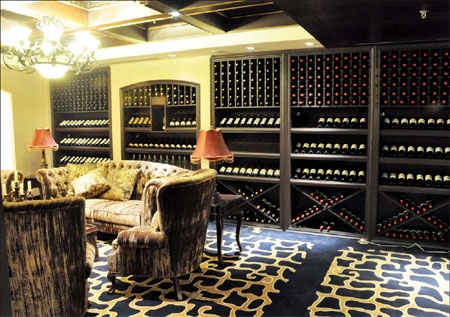 A private wine cellar is now a symbol of social status, life quality and taste. Provided to China Daily
|
Expense, it seems, has no limit to those who have acquired a taste for wines
If a wine connoisseur can spend 12,000 yuan ($1,900, 1,440 euros) on a bottle of Lafitte or Latour, he or she probably has enough money to build a private cellar to store the investment.
As demand for fine wine, especially expensive vintage wine, soars in China, wine cellar design firms are becoming well-versed in interior and wine storage design.
In recent years, wine has begun to denote wealth. High-end open houses and luxury new car releases frequently revolve around wine tasting parties.
According to the International Wine and Spirit Research's 2012 China Wine Market Report, wine consumption in the country increased 33.4 percent year-on-year to 156 million nine-liter cases (12 750-milliter bottles a case) last year. China is the world's fifth biggest wine consumer after the United States, Italy, France and Germany.
"A professional, private cellar is not only a cradle of the Grand Cru babies, but is also a symbol of social status, life quality and taste," says Chen Qiang, referring to a quality wine. He is the chief designer heading a 20-strong team at Sicao Wine Cellar in Shenzhen, one of China's earliest cellar design firms.
Chen, who used to be an interior designer in Shenzhen, first came to Beijing in 2006 to design a cellar for a Spanish restaurant.
"At first, we were actually learning from the European cellars and exploring our own ways to construct a local one in a different climate and a different situation."
Chen's company has grown rapidly in Beijing since 2006. He says revenue has been growing at least 70 percent a year.
"Only three people out of a hundred might know what wine storage cabinets were in 2007. But now, more than 30 would say they have heard about them."
Most of the cellar owners are business tycoons or celebrities who have a yearly income of at least 10 million yuan.
"We intend no offense, but our customers naturally belong to the upper class. They travel frequently among countries and bring back the wine they like. Anyway, they have to be affluent enough to build a cellar and moreover, to fill it."
"The biggest collector I have worked for has more than 30,000 bottles of vintage wines, which would probably amaze many wine sellers." He is now working on a huge project, a 6,000 to 9,000-square-meter cellar for a celebrity that will cost at least 40 million yuan.
More than 960,000 people on the mainland have personal wealth exceeding 10 million yuan; about 60,000 are billionaires. Beijing, Guangzhou and Shanghai top the list of cities home to those with personal wealth of more than 10 million yuan, with 170,000, 157,000 and 132,000 millionaires in each city respectively, according to the 2011 Hurun Wealth Report.
In line with the report, custom wine cellars are mostly found in Guangzhou, Beijing, Shanghai and Shenzhen. Cellar design firms first appeared in coastal cities in southeastern China, close to Hong Kong, in 2004 or 2005. They have been expanding their business to Beijing, and Sichuan and Shanxi provinces.
Wine is best stored at a constant temperature (12 C to 15 C) and humidity (about 65 percent), low lighting, free from vibration and optimum racks.
"An air conditioner to control the temperature and humidity is the soul of a cellar," says Li Chunhui, general manager at Wine Town's Beijing office, stressing the importance of the cooling system.
Chen says cellars in China are usually equipped with better functioning cooling systems than those in Europe.
"Chinese moneybags always want extremely good equipment, even when they aren't quite familiar with it. For example, one will first buy all professional equipment and clothing before learning how to ski, even better equipped than professional athletes," he says.
The cost of a basic cellar ranges from 15,000 to 30,000 yuan. A 20-square-meter cellar, which can store at least 500 bottles of wine, costs about 400,000 yuan.
Only 10 percent to 20 percent of the total cost goes toward the design and planning, 20 percent is for cooling and 60 percent is for fittings, such as wine racks and decorations, says Chen Liang, general manager of Shenzhen Raching, one of the top three wine storage solution providers in China.
Raching's success is another piece of evidence of the soaring demand in the wine storage market. For each of the past three years, Raching's revenue has grown 100 percent. Its revenue last year topped 200 million yuan.
Cellar design firms are the typical partner with architecture design studios and real estate companies.
"Real estate companies are sparing no effort to make high-end properties more competitive. A property with a fine wine cellar is becoming more appealing for homebuyers," Chen Liang says.
Designers sometimes struggle when they are told to put fashion before function. Some customers request a wine rack made of rare Hainan scented rosewood or sandalwood, pushing the total cost to more than 10 million yuan for a 20-square-meter cellar.
"The most expensive does not mean the best," says Xie Jiaxin, sales manager of Wine Town Cellar Design. "The optimum wood for the wine rack should be oak, for it is not likely to become deformed in the environment of low temperature and high humidity."
Wine Town, based in Shanghai, is one of the top custom wine design companies in China. It plans to establish another office in Shanxi province this year. "Cottages in Shanxi are usually very big and cellars of hundreds square meters are very common there, perhaps due to the relatively low housing price and the many wealthy people there," Li says.
The potential of the Chinese wine storage market is unknown, because China is far from the land of vintage wine. Unlike people in France who can buy high-quality wine at any time, Chinese need good conditions for wine storage to safeguard and improve the quality of their Premier Cru treasures, Li says.
"Wines are never dead things. They are like sleeping beauties, and they grow in bottles as time goes by. You have to provide them with the right shelter."
Apart from the storage function, private cellars give much added value to homeowners. The rich are usually only too eager to impress their friends and guests with a large collection of fine wines in their cellars.
"There is a gradual recognition among wealthy wine lovers. It is sometimes even regarded as the code to enter the upper class."
Li believes a private cellar shouldn't just be a privilege for wealthy people. As knowledge and awareness of wine storage spreads, more wine enthusiasts can construct them.
The most unforgettable project he has worked on was a 10-square-meter cellar, which cost about 100,000 yuan, for a retired worker in his old apartment.
"It was a small one, but delicate and full of joy," he says.
- “中国梦·世界情”中国品牌全球行北京首发盛大启航
- 5-29
- 雷雁
- 毛铺苦荞酒获“白酒国家评委感官质量奖”
- 8-18
- 童国强
- 这些地方招人,博大酒水人才网带你去看看!
- 5-29
- 第93届全国糖酒会为何选择南京——专访全国糖酒会办公室主任古平
- 5-29
- 孙文东
根据《中华人民共和国著作权法》及《最高人民法院关于审理涉及计算机网络著作权纠纷案件适用法律若干问题的解释》的规定,本网站声明:
凡本网注明“来源:《华夏酒报》”或“来源:中国酒业新闻网”的所有作品,版权均属于华夏酒报社和中国酒业新闻网,未经本网授权不得转载、摘编或利用其它方式使用上述作品。已经本网授权使用作品的,应在授权范围内使用,并注明来源:《华夏酒报》或中国酒业新闻网。违反上述声明者,本网将追究其相关法律责任。
凡本网注明来源:XXX(非中国酒业新闻网)的作品,均转载自其它媒体,转载目的在于传递更多信息,并不代表本网赞同其观点和对其真实性负责。我们力所能及地注明初始来源和原创作者,如果您觉得侵犯了您的权益,请通知我们,我们会立即改正。
如因作品内容、版权和其它问题需要同本网联系的,请在30日内进行。 如果您有任何疑问,请联系我们:wlb@hxjb.cn
 互联时代,酒类电商的明日走势
 一购三赢?详解青青稞酒并购“中酒网”
 华夏酒报荣获中国商业文化建设传播奖
 三条酒类广告禁令考量社会责任