First there was the Bordeaux bubble. Then came Moutai mania. What drink will next take China’s nouveau riche by storm?
Perhaps nothing more exotic than a good pint of beer. But there is one caveat – it will help to have snob appeal, according to a study published this week by market research group Mintel.
Beer is hardly new to China. It already consumes more beer than any other country in the world. The global brewing goliaths, SABMiller and Anheuser-Busch InBev, have long been on the ground fighting for – and winning – market share. And China has plenty of its own established brands such as Tsingtao and Snow.
However, Mintel says that two new trends make China positively yeasty with potential for high-end international brewers.
“Consumers are not only drinking more beer, but are also beginning to drink more expensive beers,” says Matthew Crabbe, director of China research at Mintel.
China’s burgeoning taste for wine has dominated the headlines, but beer may be a safer bet for investors in the Chinese drink market. Mintel notes that the Chinese wine market grew 52 per cent in 2010 but slowed to 12 per cent last year, while spirit sales decelerated from 24 per cent to 16 percent. Beer, though less fizzy to begin with, has been steadily creeping upward – sales growth went from 7 per cent in 2010 to 13 per cent last year.
The numbers also reveal a drift into premium territory. In the five years to 2011, the Chinese beer market grew by 29 per cent in volume terms to 50bn litres, but by 63 per cent in value terms, making for a market value of Rmb454bn ($71bn). In other words, the average value per litre of beer sold in China has risen 27 per cent since 2007.
So is it time for Chateau Lafite to shove over and make room for Trappist monks? Crabbe thinks so:
The recent drop in growth of wine and spirits sales could leave room open for high-end ‘snob-brews’ to find new interest. Indeed, the fact that wine and spirit sales have dropped, despite having enjoyed really strong recent growth, makes it the perfect time for premium beers to press the right kind of new interest buttons of the ever-fickle Chinese brand- and image-conscious consumers.
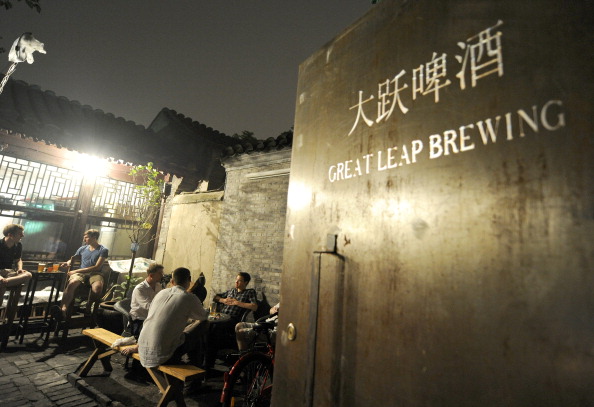
Not one to flinch in the face of dangerous assignments, beyondbrics has ventured on multiple occasions to Great Leap Brewing, a charming craft brewery in the heart of old Beijing, to see if Mintel’s market research matches the reality on the ground.

Great Leap bar, Beijing. A tough BB assignment.
Carl Setzer, a burly American beer aficionado, founded Great Leap three years ago and says that he’s seen a clear increase in Chinese drinkers during that time. Locals now account for about 40 per cent of his client base, though just a quarter of sales (expats, it seems, are bigger lushes).
Great Leap produces ales with flavours far stronger than the watery lagers that are most popular in China. So the beer is not instantly accessible to Chinese drinkers – but ultimately it is far more accessible to them than wine.
Chinese drinkers are infamous for cutting their wine with Sprite. Setzer says that has only happened twice with his beer over the past two years:
Airplane magazines tell Chinese people that they need to buy wine, so they buy it but they don’t like it. We’ve been seeing a lot of enthusiastic customers who want to get away from wine…. Beer, they understand. They don’t need a sommelier to explain it. Beer is a drink they already get. This is just a high-end version.
- “中国梦·世界情”中国品牌全球行北京首发盛大启航
- 5-29
- 雷雁
- 毛铺苦荞酒获“白酒国家评委感官质量奖”
- 8-18
- 童国强
- 这些地方招人,博大酒水人才网带你去看看!
- 5-29
- 第93届全国糖酒会为何选择南京——专访全国糖酒会办公室主任古平
- 5-29
- 孙文东
根据《中华人民共和国著作权法》及《最高人民法院关于审理涉及计算机网络著作权纠纷案件适用法律若干问题的解释》的规定,本网站声明:
凡本网注明“来源:《华夏酒报》”或“来源:中国酒业新闻网”的所有作品,版权均属于华夏酒报社和中国酒业新闻网,未经本网授权不得转载、摘编或利用其它方式使用上述作品。已经本网授权使用作品的,应在授权范围内使用,并注明来源:《华夏酒报》或中国酒业新闻网。违反上述声明者,本网将追究其相关法律责任。
凡本网注明来源:XXX(非中国酒业新闻网)的作品,均转载自其它媒体,转载目的在于传递更多信息,并不代表本网赞同其观点和对其真实性负责。我们力所能及地注明初始来源和原创作者,如果您觉得侵犯了您的权益,请通知我们,我们会立即改正。
如因作品内容、版权和其它问题需要同本网联系的,请在30日内进行。 如果您有任何疑问,请联系我们:wlb@hxjb.cn
 互联时代,酒类电商的明日走势
 一购三赢?详解青青稞酒并购“中酒网”
 华夏酒报荣获中国商业文化建设传播奖
 三条酒类广告禁令考量社会责任